Holding the door open.
Saying something encouraging.
Picking up litter on campus.
All these acts, while seemingly small, may have a large and lasting impact on someone’s day. Small gestures of kindness seem to be increasingly less common in everyday life. What was once considered to be the bare minimum — merely good manners — has become rare enough to be noticed.
In Lower School, faculty members like first grade teacher Elizabeth Beacom are working to make sure that Marksmen are taught kindness and other essential virtues from a young age.
“We have two character traits every month,” Beacom said. “This past month (the students) learned about kindness and respect.”
The school works to continue to strengthen this base of kindness and respect throughout the boys’ time at the school through their Character and Leadership curriculum.
Dr. GayMarie Vaughan, who teaches English 10 as well as Literature of Human Rights, believes that people should be role models in order to spread kindness and other virtues.
“(We should) model kindness, respect, openness and growth mindset, all those things,” Vaughan said. “Even discipline in terms of holding your tongue when you want to lash out.”
Contrary to popular belief, kindness is something that takes practice to become good at, like any other skill.
“I hope that we get better at practicing kindness because these are habits we develop, and unless we practice them, we’re not going to get good at them,” Vaughan said.
In Vaughan’s Literature of Human Rights class, her students have frequent debates on new political issues like the death penalty. She emphasizes the educational aspect of the topic, which helps turn down the heat.
“Everybody has an opinion,” Vaughan said. “But I think (we should) maintain a position of learning and presenting facts like, ‘what is the history? What do the statistics say?’ I tell the boys, ‘I’m not here to tell you what to think about this. I’m just asking you to think about it.’”
Vaughan highlights the importance of emotional control in difficult situations.
“Respond, don’t react. There’s a huge difference between responding and reacting,” Vaughan said. “If somebody is gonna come at you, or if you see something that’s intended to evoke a response, take a minute and try to understand where that person is coming from.”
Even in difficult situations like arguments, Vaughan stresses that people still need to exhibit kindness in addition to maintaining one’s composure.
“I think learning to dial down the heat is a good thing, remembering that it’s more important to be kind than it is to be right,” Vaughan said. “If your intent is to put someone in their place or have a sense of superiority like, ‘Oh, I just won that argument,’ that’s not good.”
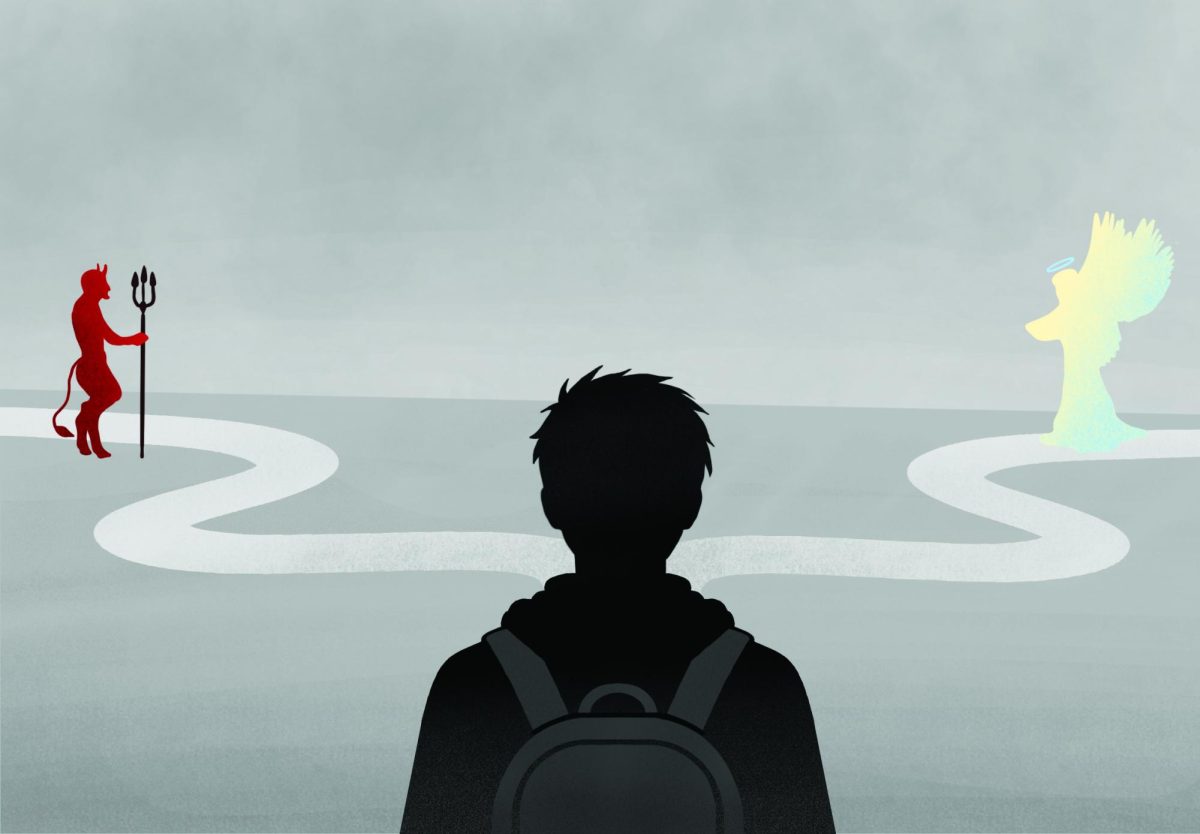
Junior Payton Elder believes kindness is a conscious decision, not just something that comes naturally.
“I think humans are wired to judge people,” Elder said. “When you bring awareness to the fact that your brain wants to judge people, and you realize that in the moment that you’re judging people for superficial things, you have to bring awareness to that and make a conscious decision to change the way you’re thinking and eventually that will become habit.”
That realization is often easier said than done, and students often find themselves subconsciously judging those around them. Even at school, where virtuous behavior is stressed on such a high level that often leads to false expressions of kindness, it is becoming increasingly more difficult to differentiate those who are being genuine from those who are not.
“I think the Character and Leadership program does a great job of telling us who we should be,” Elder said. “And with that it puts a damper on moral development and confines it to the classroom by giving us tests on vocab words verbatim. It makes being a good person a chore rather than a responsibility that we feel.”
While the idea of a curriculum that focuses on building character and leadership works in concept, students often believe that it encroaches on their ability to develop those positive traits in their own ways.
In many cases, students approach the character and leadership focus of the school as a chore and mundane task that has to be completed rather than something to take advantage of and grow from.
But kindness can’t be fully institutionalized — it isn’t a vocabulary word or checklist. It’s a consciously developed habit built from the small, quiet choices practiced every day, long after the lesson ends.