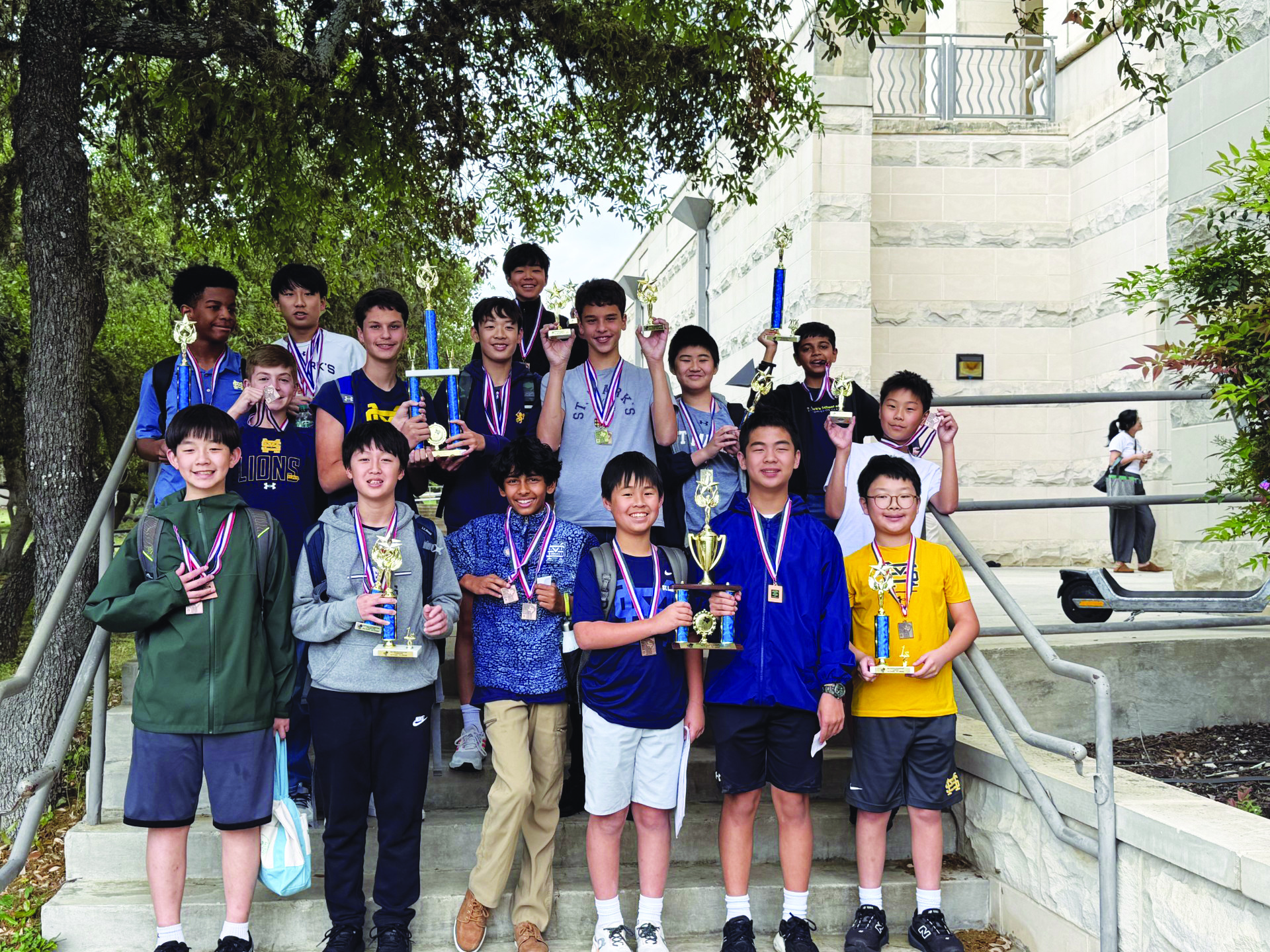
Nothing feels quite like first place. Yet, for the Lions’ Middle School math team, the feeling has almost become routine, culminating in a standout performance at the Texas Math and Science Coaches Association (TMSCA) 5A State Championship on April 11-12 in San Antonio, Texas.
Competing against top schools across the state, the boys finished first place in the ‘Mathematics’ team category and fifth overall in sweepstakes, posting a total of 3,448.04 points, with particularly strong showings in Number Sense (794 points), Calculator Applications (749 points) and Mathematics (654.24 points).
The team’s first-place finish in the mathematics section — led by sixth grader Cyrus Kuang, eighth grader Roger Wang, seventh grader Max Cao and eighth grader Dhilan Saluja — stood out as the defining achievement of the weekend; the result reflects not only individual excellence but also a collaborative team effort that carried over from practice into competition.
“We all knew each other before we went to San Antonio, so there were a lot of close friendships,” Wang said. “We were doing practice tests on the bus ride and helping each other.”
The TMSCA competition evaluates students across four categories — Number Sense, Calculator Applications, Mathematics and Science — with team scores determined by the top four performances in each event. Mathematics and Science scores are scaled, while Number Sense remains unadjusted, creating a balanced system where consistency across events is critical for team success.
Within that structure, the team demonstrated both depth and specialization. Kuang led the field with a first-place finish in mathematics and third place in Number Sense, while Wang placed third in mathematics and 17th in Number Sense. Cao added a fourth-place finish in mathematics, and Saluja contributed top-10 placements in both Number Sense and mathematics.
“It felt really rewarding because I put a lot of work in, so it felt really nice to win,” Kuang said. “For the math section, I knew I was top 20, and when they got to number two and my name still wasn’t called, I knew I was first place. It was really exciting.”
Behind the results lies a practice structure that relies heavily on student initiative. The team meets formally just once a week, placing the responsibility for improvement on individual effort outside scheduled sessions.
“Math team is an extracurricular club, so we meet once a week for 30 minutes. . . All the work the boys do is on their own time, evenings and weekends,” club sponsor Lynne Steckler said.
That independence has become a defining feature of the program, encouraging students to take ownership of their preparation and develop habits that extend beyond competition.
“They really just take initiative and do it, because they realize to do well, the work has to get done, and they just figure it out,” Steckler said.
Students approach that preparation in different ways, often tailoring their study methods to fit their strengths. Some emphasize conceptual understanding, while others focus on repeated practice across the four categories.
“I didn’t really focus on the practices as much as learning new concepts,” Wang said. “I used books and focused on understanding before doing a lot of practice tests.”
Others adopt a broader philosophy, treating all areas of competition as extensions of the same core skill set: Mathematics.
“My philosophy is that all math is the same as all other math, so for practice, I just do math,” Cao said. “For every competition, I do some practice tests, but not a lot of practicing for that exact test.”
The competition itself demands not only knowledge but also strategy, however. In events like Number Sense and Calculator Applications, scoring rewards speed and accuracy while penalizing incorrect or skipped answers, forcing students to make quick decisions under pressure.
“It’s time-based, so you need strategy… if you don’t know a question, you skip it, do the ones you know first and then come back if you have time,” Wang said.
Beyond individual tactics, the team’s success also reflects leadership. With coaches unable to enter competition rooms, experienced students must guide their peers and maintain focus independently.
“The current eighth graders definitely filled the void and did a great job,” Steckler said. “When needed, they stepped up as leaders.”
That leadership, combined with strong performances across multiple events, contributed to year-over-year improvement for the program.
“We came in first place in General Math, fifth place in Number Sense and fourth place in Science — we improved in every category from last year, and we had seven fewer guys,” Steckler said.
Even with the team’s success, many competitors remain focused on future growth. For Cao, earning fourth place in Mathematics at the state meet was less an accomplishment and more a benchmark for what comes next.
“It’s honestly not what I expected,” Cao said. “I expected a better placement, but it’s still a good placement, so I have mixed feelings.”
Looking ahead, the team’s younger members — many of whom contributed significantly this year, including Cao — will have opportunities to build on their experience and aim for even higher finishes.
“Next year, I want to get state champion,” Cao said. “I need to practice math team on its own more, because just doing math doesn’t mean you’ll do well in every category.”
As the program continues to develop, its combination of individual dedication, peer collaboration and strategic preparation positions it as a consistent contender at the state level.