
It’s Saturday morning, but campus is still buzzing with life.
Boys come to school for reasons ranging from sports to academics and extracurriculars, free from the strict, dress code that administrators mandate on school days.
But even without dress code enforcement, there is an apparent lack of style. Not because of a lack of capability, but because of a lack of effort.
The school has built a culture around uniformity in more ways than one might notice. Everyone wears shorts every day. Few people pull their socks up beyond their ankles. This culture pervades both the middle school and upper school.
“I think we put less thought (to what we wear) because we just wear the same thing every day on weekdays, so we don’t really think about what we put on, so it may translate to what we wear outside of school,” seventh grader Christian Collins said.
Students may be looser in the way they dress due to the a judgemental free environment at St. Mark’s. At other schools people may dress to impress others or represent themselves. Marksmen aim for comfort and ease rather than appearance.
“I think (it’s a) St. Mark’s thing about our students, (or) maybe just because we’re all boys, or maybe just because we’re all really close,” freshman Ishaan Siddamshetty said. “No matter if you’re in different friend groups, we all really don’t judge each other. I think it’s just the way St. Mark’s kind of molds us is that we learn not to judge people no matter what they wear.”
Siddamshetty believes that uniforms impact dress outside of school, but still thinks uniforms are effective to students.
“I feel like (uniforms) are a pretty good method that St. Mark’s has implemented, “ Siddamshetty said. And also, it kind of states that discipline part having to do the same thing every single day, and getting the same dress, making everybody on an equal stage.”
Sophomore Adam Zhang suggests that uniforms may actually help students bond with each other.
“You go to St Mark’s and not only is there a level of prestige to that, but also you can feel proud that you are among your friends and among your brothers, and you have something special to say when you grow up,” Zhang said. “You’re like, ‘I used to be part of this really tight knit community, and we used to all wear the same thing.’”
Henry Friedman, a freshman at Highland Park High School, offered an outside perspective on how uniforms shape fashion as individuality.
“I actually think (expression) is really important just because I feel like there’s just a sense of just being happy with the clothes you choose,” Friedman said. “If you really can’t, if you’re just limited to the clothes you’re allowed to wear, you won’t really be able to express yourself. You just can’t really show your true self to anybody surrounding you.”
He believes that clothing can build a group identity or an individual identity.
“Certain clothes could 100% associate you with something in a good way or in a bad way,” Friedman said. “I think just choosing your clothes, 100% individual, will individuate you from a different person.”
Siddamshetty gives the example of clothes representing someone’s personality.
“I feel like a good example is really vibrant colors, because sometimes I’ll wear mustard yellow shorts, or pink shorts, and some people, if they’re shy, they’ll never wear stuff like that, because they don’t want to express themselves, or they kind of want to keep in their shell,” Siddamshetty said. But people who are extroverted, they love wearing all those vibrant colors.”
Athletics also play a role in the lack of sartorial diversity outside of school. Athletes are likely to be more concerned about the functionality of clothes rather than how they serve to express themselves.
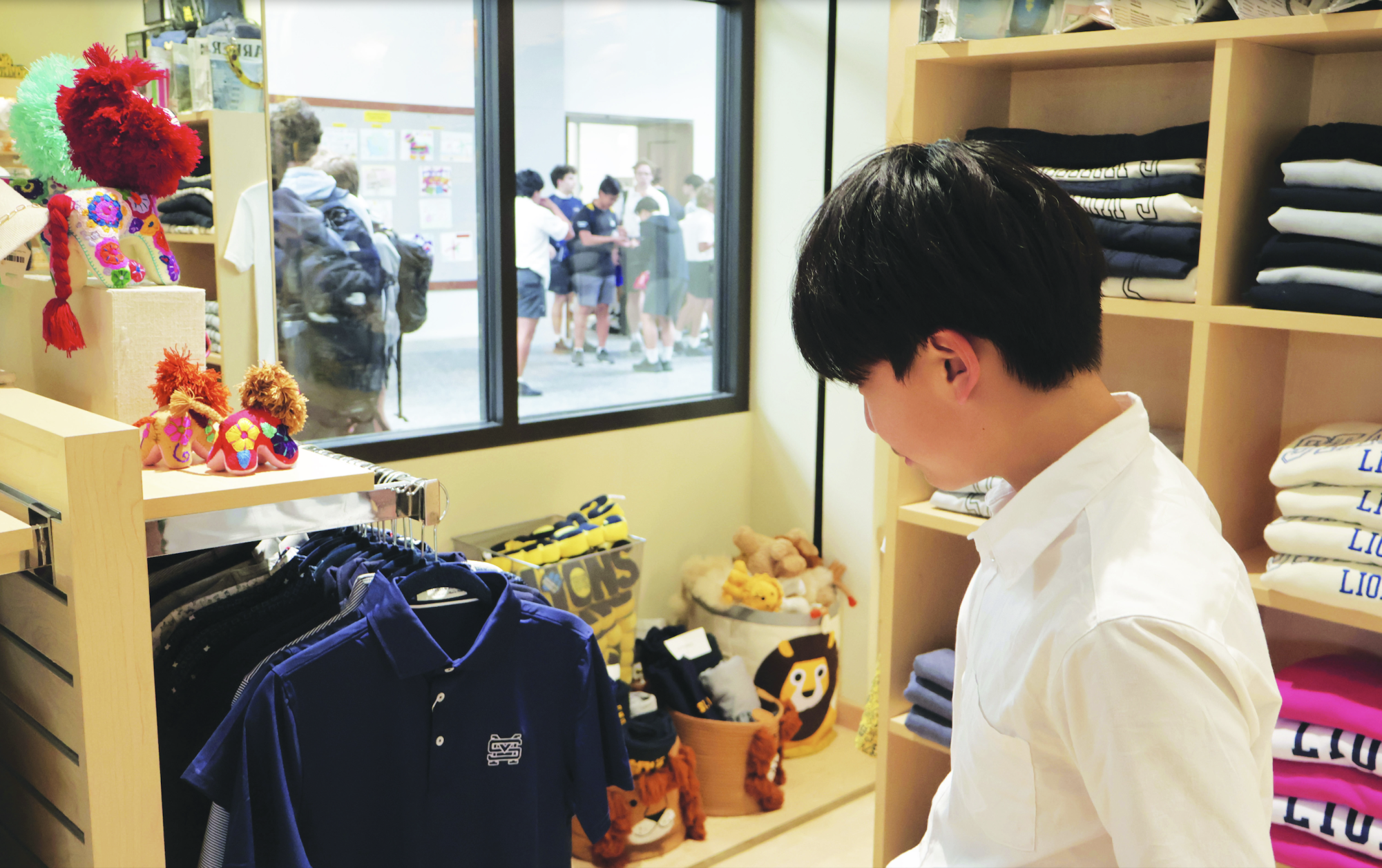
Conveniently, the Student Store sells branded athletic apparel for when students forget to bring their non-uniform clothes. This, in tandem with school pride, leads many to wear lots of school branded clothing.
“I do fencing a lot, so I’ll wear a lot of athletic clothes and a lot of St. Mark’s branded stuff from the student store,” Siddamshetty said. “At the fencing club, whenever I see somebody from St. Mark’s, the majority of the time, they will be wearing some sort of St. Mark’s merchandise.”
For students who wear the school logo outside of school, their clothes carry meaning and represent something more than fashion.
“We’re often told St. Mark’s students are ambassadors of the school, right? And whenever they wear that St. Mark’s clothing, they’re kind of bringing that idea of St. Mark’s around with them,” Siddamshetty said.
Siddamshetty realizes when he wears the school logo, his actions and words add to our school’s reputation.
“Whenever I wear St. Mark’s shirt, there’s always some point during the practice where when I say something, I realize, Oh, this is probably what they think of St. Mark’s students. That does kind of influence the way, not only the way I dress, but also the way I speak, the way I upfold myself whenever I have that logo on,” Siddamshetty said.
Zhang thinks that being at a school with a uniform strongly influences how individualistic one’s style is. He believes that in contrast to the early 1900s, what people wear doesn’t matter as much anymore.
“Back in the day, they actually had lots of unspoken rules about what you can wear and what you cannot,” Zhang said. “You had to hold yourself to a high standard to be in high society. Nowadays, people care less about that and more about how good of a person you are and how hard working you are, which is honestly just a fantastic evolutionary part of our society.”
In contrast with the 1900s, modern day fashion for most students comes from what they see in the media. Students have started to copy other people’s style rather than creating a style of their own.
“I know a lot of other students have social media, and I know that that’s what influences the way they dress, because they kind of want to imitate the people they see online, and I don’t really agree with that ideology, but I know that’s what differentiates me from a lot of other kids,” Siddamshetty said.
This concept of taking an image or trend from the media and implementing it in your everyday life is often labeled as performative.
“Fashion is very performative,” Zhang said. “I don’t think being performative is bad, but there’s lots of performative people who are very pretentious at the end of the day. If it makes you feel good, you should do it.”
Zhang stresses that fashion has benefits outside of appearance and can help improve the way that one views themselves.
“I think other people get out of fashion a sense of confidence,” Zhang said. “People talk about confidence as much as it should be (talked about). If you wear something nice, I think it makes you feel really confident, and it helps you with your life.”
Zhang feels that fashion should increase confidence and self image. He emphasizes the necessity of putting yourself out there and not being afraid to express yourself.
“I think everyone should strive,” Zhang said. “If you want to get into individual, individualistic wear, you should find something meaningful in wearing something unique.”