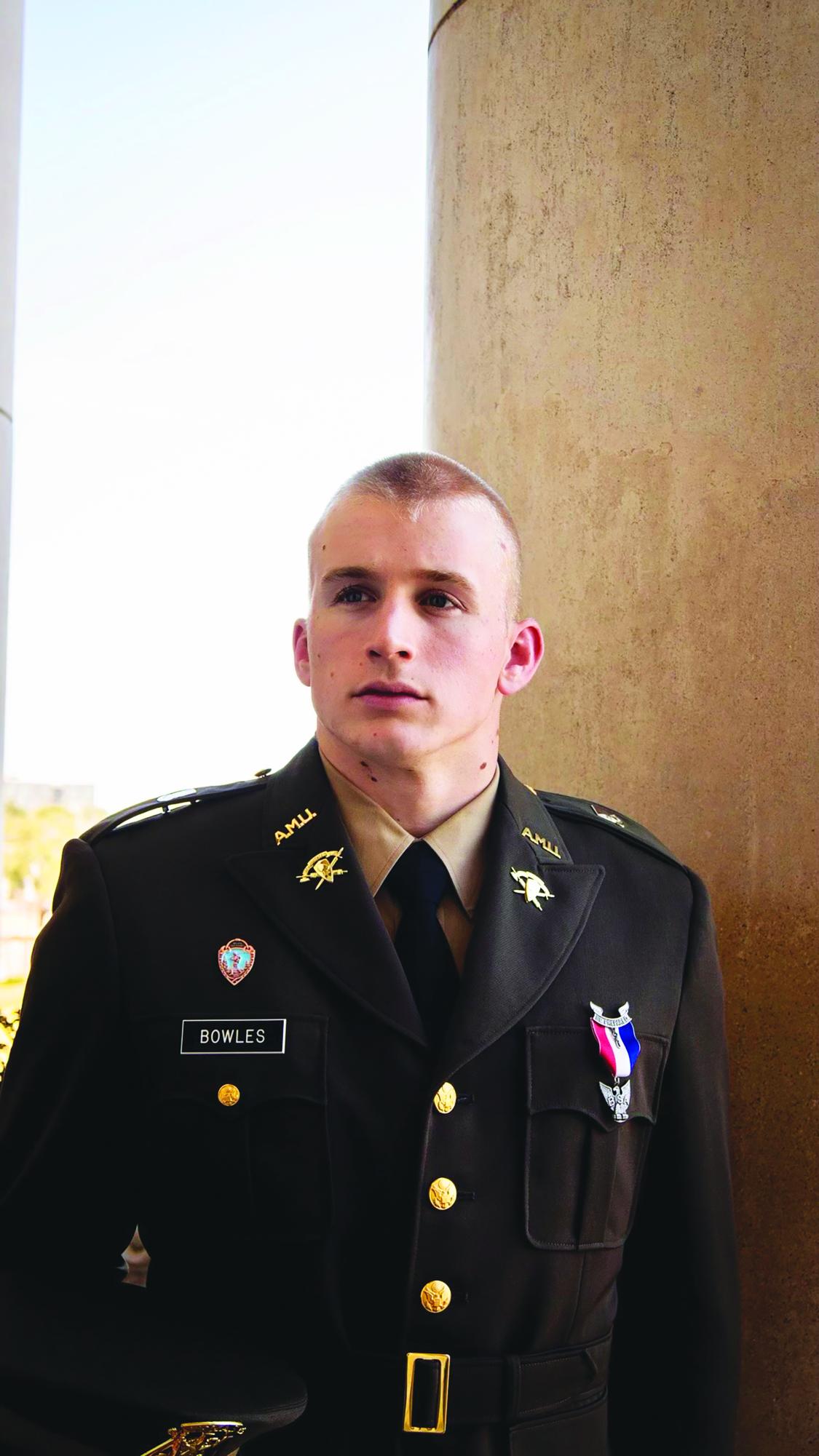
Every morning, Gavin Bowles ’25, a freshman at Texas A&M, wakes up at 4:30 a.m., makes his bed, sweeps the floor and cleans his dorm room — as a freshman, his room has to be spotless.
At 5:20 a.m., Bowles does an hour of grueling physical training. Then, he’s off to classes.
When he returns at 4:30 p.m., he has yet another session, this time for field training and drills. At 10:15 p.m., he goes to sleep, repeating this cycle every single week.
Bowles, a member of Texas A&M’s Corp of Cadets Reserve Officers’ Training Corps (ROTC) program, doesn’t shy away from this rigorous, military-style routine. In fact, this structured lifestyle was partially what convinced him to join ROTC.
“I felt called to do that and serve,” Bowles said. “It matched with some of the ideals that I was going for in terms of development over the course of my life. I was looking for a disciplined atmosphere, a high emphasis on physical fitness and respect – the core values that you would expect from a military type environment. I saw it as a higher quality and a way to maintain motivation to improve myself.”
Bowles is set on becoming a military officer: in fact, he had planned on pursuing ROTC since the beginning of high school. In addition, next year, Bowles plans on transferring to the United States Military Academy at West Point, and after four years of college, he will enter into the Army.
The ROTC was initially created as part of the National Defense Act of 1916 with the goal of creating a larger population of military-ready civilians at non-military academies for the imminent war effort. Further conflicts, especially World War II, would increase the pool of cadets and add scholarships to incentivize joining.
However, during the Vietnam Era, many of these contracts were revoked because of public pressure. In the 1980s they were reinstated, and are being used by students like Bowles.
“I personally got an ROTC contract, which means that I will commission,” Bowles said. “It also means my college is free. They’ll look at your numbers, and they’ll look at your GPA and your fitness test scores, and if they’re good enough, and they have a slot, they’ll give you a contract, they’ll pay for your tuition, and they’ll give you mandatory service: two years of service for every one year paid for college.”
In Bowles’s case, he knew he wanted to serve in the military since high school, meaning that he could obtain his contract extremely early on.
For those who obtain contracts before college, like Bowles, the applicants typically apply using letters of recommendation and sponsorships from state congresspeople. Many cadets, however, can also obtain their contracts early in their college career.
“One of the ways to do it (in high school) is to have a recruiter hold your hand through the entire thing,” Manny Rubio, a current cadet at Texas A&M, said. “But now we kind of have, we don’t have recruiters, but we just have, like actual officers on campus who like, work with the contracted people. And there’s different routes depending on what branch.”
In addition to providing government-funded contracts, pursuing a military career opens the door for future career opportunities. Bowles plans on applying for law school, with his tuition being paid entirely by the government. From there, he will be recommissioned into the Judge Advocate General’s Corps (JAG), where he will practice law for the military.
“I’ll be recommissioned as a JAG corps officer, which is army law,” Bowles said. “Then eventually, you know, once I hit however many years, I’ll get out and probably do corporate law.”
However, before then, Bowles has to complete at least eight years of military service, and his daily routine in college, consisting of physical training and field training, are all preparing him for life in the military.
“In PT, sometimes you’re just like running unnecessarily hard, doing bear crawls, doing a ton of uncomfortable calisthenics or mud PT, just to just kind of test your mentally,” Bowles said. “Other times, you’ll hit a really good lift or do a good endurance run. It’s kind of a combination of both mental, mental and physical training.”
In addition, Bowles learns combat tactics from field training, teaching him directly applicable skills for the military.
“For field training, we primarily do infantry tactics. We’ll train attacks, raids, ambushes and movement-to-contact,” Bowles said. “They teach how you attack an objective, how you clear it, how you do the different orders, how you take care of casualties or clear enemies and how you take prisoners of war.”
Ultimately, ROTC takes up a large portion of Bowles’s day. This extra burden, on top of his academic workload, can be difficult to manage. Even still, Bowles appreciates the extra work he puts into the program.
“I would much rather be doing this than being a regular college student,” Bowles said. “But you have to care for this lifestyle. It’s definitely not for everyone.”
“One of the ways to do it (in high school) is to have a recruiter hold your hand through the entire thing,” Manny Rubio, a current cadet at Texas A&M, said. “But now we don’t have recruiters, we just have actual officers on campus who work with the contracted people. And there’s different routes depending on what branch.”
In addition to providing government-funded contracts, pursuing a military career can open the door for future career opportunities.
Bowles, for example, plans on applying for law school, with his tuition being paid entirely by the government. In addition, he plans to be recommissioned into the Judge Advocate General’s Corps (JAG), where he will practice law for the military.
“I’ll be recommissioned as a JAG corps officer, which is army law,” Bowles said. “Then eventually, once I hit however many years, I’ll get out and probably do corporate law.”
Before then, Bowles has to complete at least eight years of military service, and his daily routine in college, consisting of physical training and field training, are all preparing him for life in the military.
“In PT, sometimes you’re just running unnecessarily hard, doing bear crawls, doing a ton of uncomfortable calisthenics or mud PT, just to test your mentality,” Bowles said. “Other times, you’ll hit a really good lift or do a good endurance run. It’s a combination of both mental and physical training.”
Bowles also learns combat tactics from field training, directly teaching him applicable skills for the military. These training sessions are meant to build teamwork and create an organized group of cadets.
“For field training, we primarily do infantry tactics. We’ll train attacks, raids, ambushes and movement-to-contact,” Bowles said. “They teach how you attack an objective, how you clear it, how you do the different orders, how you take care of casualties or clear enemies and how you take prisoners of war.”
Ultimately, ROTC takes up a large portion of Bowles’s day. This extra burden, on top of his academic workload, can be difficult to manage. Still, Bowles appreciates the extra work that he puts into the program.
“I would much rather be doing this than being a regular college student,” Bowles said. “But you have to care for this lifestyle. It’s definitely not for everyone.”