

When sophomore Cho walked back onto Dallas soil this year, it wasn’t the city that felt unfamiliar; it was the school. He had lived in Dallas before, spent years growing up here, and knew the place well.
But stepping onto the school’s campus for the first time felt like entering a different world: faster, harder and more demanding than anything he had experienced in Korea. However it wasn’t moving that was the hardest part for him, it was the academic challenges.
“I think the hardest part was adjusting to the level of academics and the amount of work we’re expected to do,” Cho said. “Dallas itself was fine, because I grew up here. But St. Marks … it’s pretty tough.”
Before coming to St. Marks, Cho attended an international school in Korea, an American-style private school that offered strong education, but nothing like the challenges encountered here.
But if there was one thing that helped Cho connect quickly to the U.S, it was soccer.
His transition was not only characterized by the great cultural differences that many international students face when moving to the United States from foreign countries; it was also a leap into an environment with much higher expectations of effort and time-management.
“My school in Korea wasn’t as tough as St. Mark’s,” Cho said. “It wasn’t super tied to Korean culture. It was basically just a standard American private school, nothing too extreme. But the difference with St. Marks is definitely the expectations.”
Still, despite his challenges, Cho didn’t come to the United States empty-handed. Korea shaped him through friendships and experiences. When he talks about what he misses the most it isn’t the food or vibe or even the culture. It was the people.
“I probably miss my friends the most,” Cho said. “People who had similar experiences living in America or another foreign country, then coming to Korea and going to an international school.
But if one thing helped Cho to quickly connect to the United States, it was soccer. While academics were his biggest adjustment coming onto campus, soccer gave him an identity.
In Korea, Cho’s soccer life was split into two worlds: playing soccer for his international school and playing club soccer. At the international school the experience was very similar to American private school sports, a competitive extracurricular, but not a future career path. On club teams, everything was intensified.
“For Korean public schools and actual Korean teams, it’s very all-in or nothing,” Cho said. “My teammates didn’t study at all. Their idea of a good test score was like a 30 out of 100. It was only soccer.”
This system created the biggest decision in Cho’s life. Because unless you went all in; no hobbies, no academics, no backup plan, you couldn’t realistically play soccer at a high level in Korea. And Cho didn’t want to choose just one life.
“It’s part of the reason I moved to America,” he said. “Here you can pursue soccer and still have other options and passions. That’s really amazing.”
But Cho wasn’t done adjusting. Korean soccer and American soccer are almost two different sports. Korea requires sharp skills, touch, and footwork. The American game, especially at the high school level, leans more into strength, speed, and contact.
“In Korea we spent hours mastering technique touches, drills, and the basics,” he said. “So in America, where other things like stamina and gameplay matter a lot, having that technical foundation helps. In some ways, I might even have an advantage.”
It didn’t take long for soccer to become more than a sport to Cho at his new school. It was his first community here and his fastest path to belonging. Usually walking into a new school could be intimidating, but instead soccer made it more familiar and less daunting.
“Soccer helped me make friends for sure,” Cho said. “Sports bring a different kind of community than a classroom. You go through problems together, grow closer with your teammates and coaches, and build strong bonds.”
As Cho talks about his teammates, his adjustments, the new life he’s building here in the United States, you get the sense soccer didn’t just ease the transition, it fueled it. It gave him a way to show himself, a way to connect, and a way to have fun as he navigated the hardest academic environment he’s ever faced.
Categories:
Soccer connects communities
Sophmore Ian Cho has faced many challenges moving back to Dallas from South Korea, but one thing has helped him connect to his new community: soccer.
December 12, 2025
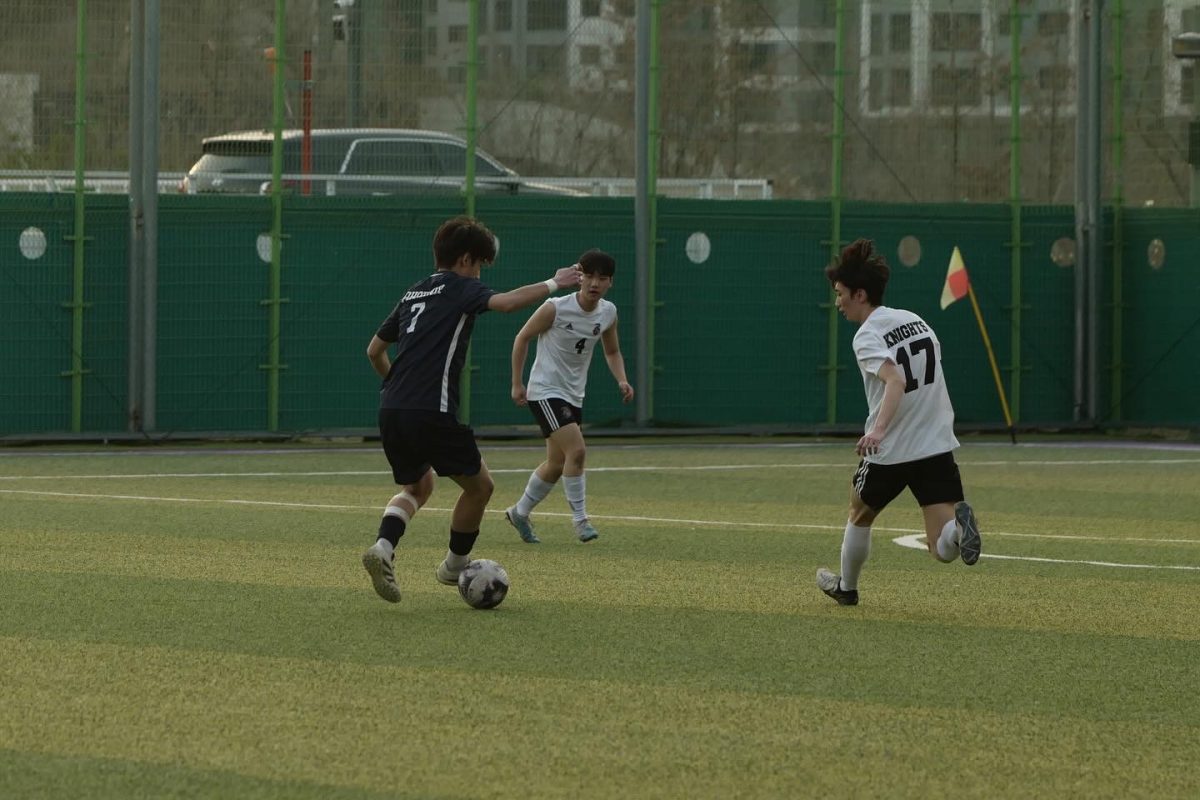
Sophmore Ian Cho facilitates and dribbles around two defenders.
More to Discover
About the Contributors