The kitchen clock reads 4:50 p.m. when junior Dylan Bosita cracks three eggs into a pan, sunny side up. The sizzle of frying cuts through the afternoon quiet. His backpack sits abandoned on the kitchen table, still stuffed with unfinished math homework and an essay he hasn’t yet started.
Those can wait.
His mom draws up her special chair to the kitchen island and asks about his day. His little brother, Brennan, joins them. For the next half hour, the Bosita kitchen becomes what it becomes every weekday afternoon: not quite a break, but something that the family has learned they need.
“It’s just a great way to decompress after school before we start homework and just dive into studying,” Dylan said.
The Bosita family doesn’t do traditional family dinners but none of them feel like they’re missing anything.
The question isn’t whether families need time together. It’s when and where that time occurs — if a kitchen counter after school ends can do the same essential work as a dinner table at 6 p.m..
For the Erick family, the answer has always been yes, the table matters.
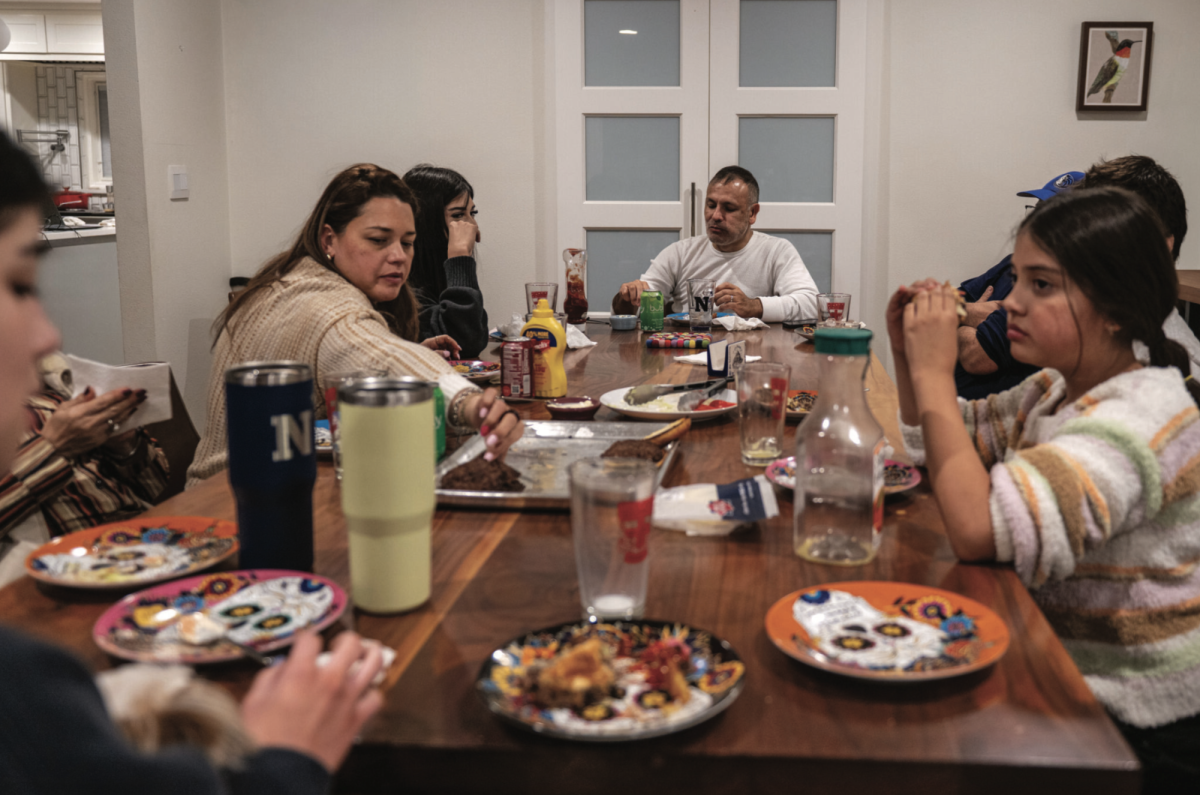
Three nights a week, around 7, the Ericks sit down together for dinner. No phones. No TV unless they’re ordering takeout. Just 10 to 15 minutes of everyone sitting at the same place, talking.
“You got to have that kind of pause in the day,” Casey Erick, father of sophomore Henry and sixth-grader Arthur said. “You have got to have that time away from your phone, work, TV and all those things because otherwise we’re all just going to end up diving into our devices and kind of ignoring each other.”
The routine is simple but deliberate. They use Blue Apron, a meal delivery service that sends pre-portioned ingredients, so that dinner doesn’t require a grocery store run. When the food is ready, Mr. Erick announces it.
Sometimes he yells loud enough for the whole house to hear. Sometimes he uses Alexa to broadcast upstairs. Sometimes, he has to text Henry to come down to dinner from his room.
The irony of the situation isn’t missed on Mr. Erick — texting someone in the same house — but it gets everyone to the table. Once they’re sitting, the conversation flows easily.
School stuff. Weekend plans. Jokes — mostly about each other — but also conversation about sports, summer programs and things they’re studying too—nothing scripted, just the rhythm of a family checking in.
The meals themselves rarely last longer than 15 minutes. But for the Ericks, that brief window has been non-negotiable since their sons were young.
“I think it’s a good idea for every family to do that,” Mr. Erick said. “I think you lose something as a family if you (don’t).”
That instinct — that something vital happens when families sit down together — is backed by decades of research on child development.
Dr. George Holden, professor emeritus of psychology at Southern Methodist University, argues that family dinners are more important now than ever, especially as teenagers navigate academic pressure and the mental health impacts of social media.
“It’s the best vehicle for open communication around the enjoyable task of eating,” Holden said.
For Holden, mealtime allows conversation to unfold naturally. In his own family, his daughter uses dinner with her two young children to ask about “roses and thorns” — one good thing and one difficult thing from the day. It’s a simple ritual that opens up honest conversation and reveals what’s really going on in their lives.
“That open communication is fundamental for healthy family relations,” Holden said. “Parents are fundamental for helping children navigate through the challenges of growing up, which are ever more difficult with social media.”
Of course, for Dylan, that traditional model has never been reality—and he doesn’t see it as a loss.
“I don’t think I’m missing out on anything,” Dylan said. “Everyone has different ways they can connect with their family.”
Between his father’s schedule as a surgeon, fencing tournaments for his brother Brennan, and Dylan’s own commitments to student council, choir and clubs, the Bosita family rarely finds itself in the same place at the same time—much less at dinner time.
Dinner happens in shifts. Food is prepped between school and activities, reheated after practice and grabbed on the way out the door.
But that doesn’t mean the vital connection isn’t happening. It’s just happening a little after 4:30 in the kitchen. Or on the way to a tournament. Or during that half-hour window when everyone briefly overlaps before scattering once more.
“Every family has a little something different in the way that they connect with each other,” Dylan said. “I think the way we’ve done it is actually the best fit for our family.”
That thirty-minute window in the kitchen after school—the eggs, the talking, the decompression—has become something Dylan looks forward to every day.
Dylan’s father, Ray Bosita, has built his family’s rhythm around a simple philosophy: adapt. As a spine surgeon with four sons—two now in college at Stanford, two still at home—Ray could be working longer hours, doing more surgeries, earning more money. But he and his wife made a different choice.
“The kids are only gonna be young once,” Ray said. “Yeah, will it cost? Well, I’d probably have to work longer since I’m taking more time now. Yes. Do I have less money than some of my peers because of this? Sure. But there are a lot of things in life that are worth more than money.”
Of course, for Dylan, that traditional model has never been reality. He doesn’t see it as a loss.
“I don’t think I’m missing out on anything,” Dylan said. “Everyone has different ways they can connect with their family.”
Between his father’s schedule as a surgeon, fencing tournaments for his brother Brennan and Dylan’s own commitments to student council, choir and clubs, the Bosita family rarely finds itself in the same place at the same time—much less at dinner time.
Dinner happens in shifts. Food is prepped between school and activities, reheated after practice and grabbed on the way out the door.
But that doesn’t mean the vital connection isn’t happening. It’s just happening a little after 4:30 in the kitchen. Or on the way to a tournament. Or during that short window when everyone briefly overlaps before scattering once more.
“Every family has a little something different in the way that they connect with each other,” Dylan said. “I think the way we’ve done it is actually the best fit for our family.”
That thirty-minute window in the kitchen after school—the eggs, the talking, the decompression—has become something Dylan looks forward to every day.
Dylan’s father, Renato Bosita, has built his family’s rhythm around a simple philosophy: adapt. As a spine surgeon with four sons—two now in college at Stanford, two still at home—Mr. Bosita could be working longer hours, doing more surgeries or earning more money, but he and his wife made a different choice.
That choice means showing up. Making the time count, even when there isn’t much of it.
“Rule number one: if it’s important to you, it’s important to me,” Mr. Bosita said. “Number two is to make every minute matter. There are a lot of things in life that are worth more than money.”
Whether it’s a five-minute drive to school, an hour-long trip to a baseball game in McKinney or a flight to Kansas City for a fencing tournament, Mr. Bosita treats that time as sacred. Those are the moments when his kids talk. When they open up. When connection happens.
“The car became our dinner table,” Mr. Bosita said.
And sometimes, those moments created memories that still make him laugh.
On long road trips, the Bosita family would play twenty questions. When his son Carson was younger and obsessed with animals, he’d always pick an animal. Every single time. And every time someone asked, “Is it an animal?” three-year-old Carson would confidently answer: “It’s not an animal.”
He thought that’s just what you were supposed to say.
Mr. Bosita knows exactly when his family’s rhythm truly clicked into place. During COVID-19, when the world shut down and the family was forced home together, the constant motion stopped. No tournaments. No meetings. No rushing between activities. For the first time in years, they had time.
Dylan remembers it the same way. Learning to cook his grandmother’s dishes. Learning to bake. Time with his brothers that wouldn’t have happened otherwise.
“I’m really, really grateful, and I’m gonna be forever grateful that I was able to spend that time with my family in the way I did,” Dylan said. “I learned to love my brothers and my family in a different way that I never had before.”
That affection didn’t disappear when life sped back up. It adapted.
On most car rides now, the Bosita family doesn’t play games or have deep conversations. They blast music—the same songs on rotation, ones they’ve heard so many times they all know the words—and sing along together.
It’s not profound. It’s not the kind of meaningful dialogue parenting experts recommend. But it’s theirs.
Holden, who has spent decades studying family dynamics, acknowledges that the setting isn’t what’s sacred.
“It doesn’t have to be over a meal,” Holden said. “But open, honest communication is really fundamental to promoting good relationships, and good relationships are fundamental to promoting healthy development.”
Whether that communication happens at a dinner table at 7 p.m. or in a kitchen after school or in a car singing along to songs they’ve heard a hundred times, the answer is the same.
The table never mattered. The time and intention do.