Hugh Feferman and Leo Hughes approach a unique sport, pole vaulting, from very different backgrounds. Hughes, a former gymnast, brings grace and dexterity when approaching the bar. Meanwhile, Feferman uses his upper body strength and weightroom training to generate the power required to lift a vaulter off the ground.
Although they view the event from opposite sides, the two vaulters share a common goal: striving to go higher every time they compete.
Feferman first joined the Lions’ track team in his junior year as a runner, specialzing in the 400-meter dash. While he enjoyed the team, he was still looking for an event he could truly excel at. Then, just before the winter break, Feferman found a video about pole vaulting while scrolling through social media.
“I saw a TikTok saying that pole vaulting required a lot of upper body strength,” Feferman said. “I thought that was really interesting, and it looked cool.”
Hughes started doing the event even before high school. As a gymnast, he developed body control, core strength and flexibility, all critical parts of vaulting.
“I first got into pole vault the summer before ninth grade because of my gymnastics background,” Hughes said. “I talked to Coach John Turek and practiced with him over the summer, that’s where I first enjoyed it and decided to stick with it.”
Hughes learned the technique from Coach Turek and Winston Lee, a former Lions’ pole vaulter and current junior at Stanford University. Aside from their coaches, Hughes, Feferman and freshman Pete DeVoss learn by coaching each other.
“Leo has been doing it for a lot longer than both Pete and I, but Pete is also on a club team,” Feferman said. “They’ve really helped me get better and taught me the technique.”
Because Feferman only started just a few months before the season, he had to learn the techniques quickly. But before he could start actually vaulting, Feferman first began by practicing his approach.
“First, I was doing what Coach Turek calls a pole run, then I moved to the long jump pit, but when I first started actually vaulting, it took probably a week before I was able to invert,” Feferman said. “It was scary to start. You’re running so fast and then stick the pole, and hopefully you did it right and don’t go flying. You really have to trust yourself.”
One way Feferman built confidence in his technique was by using his lifting background to teach himself the movements of the event.
“I’ve been into weight lifting for a couple of years now. Some of the movements in actual vaulting I’ve been able to equate to certain lifts,” Feferman said. “For example, you’re doing a shoulder press when you go to plant, then doing a row when you swing up the pole.”
As a team, the vaulters practice twice a week. When not doing their event-specific work, the athletes still have to do their track training and conditioning.
“We vault on Mondays and Wednesdays, then go to the weight room afterwards,” Hughes said. “Besides that, we do the exact same workout as the sprinters and are expected to run their intervals as well.”
Although other events take time away from vaulting practice, the team has found benefits from doing other forms of training.
“You can train for both track and pole vault without sacrificing either,” Feferman said. “To vault, you need to be able to run fast on your approach. I build that when I train for my 400s.”
While the vaulters do everything they can to stay safe, the event is hard to do outside of a competitive environment because of the risks. Due to the potential danger, it’s difficult to practice alone or as a recreational sport.
“I’ll certainly consider vaulting after high school, but I doubt that I actually will because of the amount of time it requires,” Hughes said. “It’s easy to get hurt if you don’t practice enough.”
While the training and technique of the event might be arduous, the exhilaration of being in the air keeps Hughes passionate about the event.
“My favorite part is the feeling when I get over a bar and set a personal best or when I’m in the air and have to throw the pole away to keep it from hitting me,” Hughes said. “It’s a really thrilling experience because it can also be scary at times.”
For Feferman, the joy of vaulting comes from seeing his improvements. Over three months, he’s gone from being scared to even jump to smashing his personal best on a regular basis.
“I’m on an upward trajectory right now… it’s really fun seeing that bar go up every time,” Feferman said. “That feeling of getting over and you don’t hit the bar and then on the floor, you’re just like ‘Yes!’”
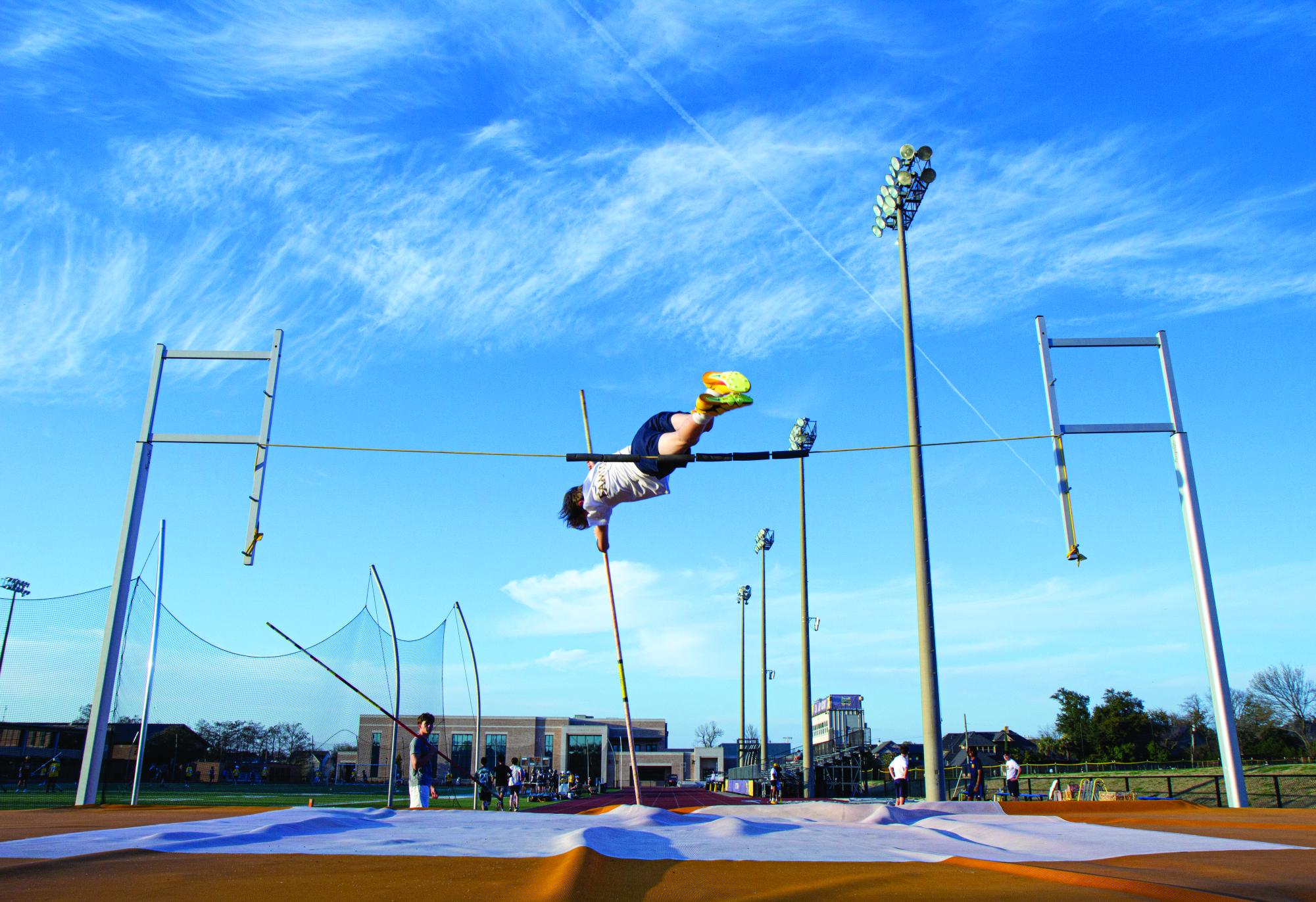
Pole vaulters reach new heights
Through one of track and field’s most distinctive events, a few Marksmen have learned to soar over their fears.
March 13, 2026
Categories:
More to Discover