
Students who excel beyond the available courses — who have “maxed out” the curriculum — are hard to come across.
But for those students, there is one special opportunity unique to the school that stretches the boundaries of what’s traditionally taught in the classroom.
An academic tutorial.
Structured in a one-on-one styled learning environment, academic tutorials generally aren’t on the radar of students, let alone a viable choice for the six class “slots” Upper Schoolers are allotted.
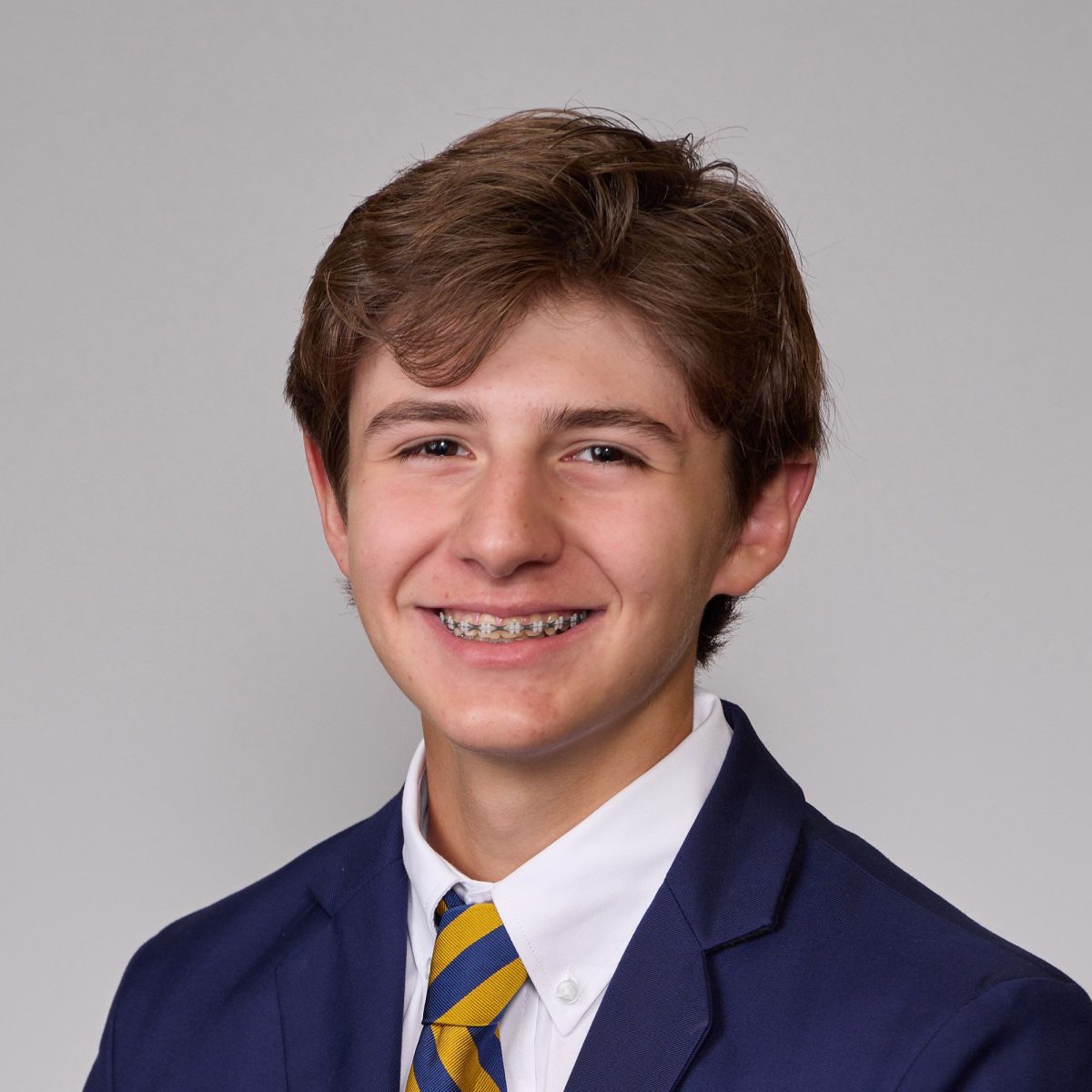
But several seniors over the years, including senior Christian Denis, have taken advantage of the somewhat rare opportunity, delving deeper into their respective fields of study, whether it be physics or botany or in Denis’ case, the Spanish language.
“I took AP Spanish Literature once I got to junior year, and I ran out of options after that,” Denis said. “So the only option after that, to fulfill my language requirement, was an academic tutorial with Dr. Erwin. And I think that it’s good for me to keep pursuing language and going beyond the curriculum, because I’ve learned a lot with him. It’s a fun class.”
There’s a reason more people don’t take advantage of academic tutorials. For one, each teacher’s time is limited. That means that only a select few students can enroll in one.
“It’s kind of hard to seek one out for yourself,” Denis said. “Usually it’s because you’ve already done everything that you can. Whether it be math or physics. If you’ve already maxed out the hardest class, then you’ll probably be able to ask for a tutorial, or sometimes the teacher will come to you (to) suggest that you take one.”
Cecil H. and Ida Green Master Teaching Chair Mark Adame has sponsored several biology-focused academic tutorials throughout his teaching career, but one of his most productive experiences has been with alumni Max Yan ’25 and Neil Jain ’25.
“I’ve done a couple academic tutorials since I’ve been here,” Adame said. “Max Yan and Neil Jain did different experiments with plants that we had found online, and we read various chapters in these botany books that I got. They also maintained the greenhouse and all the prairie restoration stuff.”
Adame believes that the success of an academic tutorial is largely dictated by the student’s personal motivation and goals. After all, anyone who wishes to pursue a tutorial must first fill out a form providing a detailed research plan along with teacher approval.
“It was fun because Max and Neil were able to take care of things by themselves,” Adame said. “I just made sure that they were okay and checked them in before we did stuff together. But they were mature enough and disciplined enough to get everything done.”
Tutorials offer a different experience for both the teacher and the student. Since classes are tailored toward individual students, classes are generally more relaxed and laid back as a result. Students don’t take regular assessments or finals. For Language Department Chair Zach Erwin ’96, his students taking tutorials write essays instead.
“When I have a tutorial, we tend to meet less often, and there is more work that the student has to do independently,” Erwin said. “Then we come together periodically to talk about what they’ve done or for them to write an essay to discuss the readings that they’ve done. But it’s different than a traditional class in that sense.”
Tutorial options in Spanish include either language or literature. Most students taking Spanish tutorials choose the literature option, opening a door to a wide selection of readings and texts.
“In the tutorial that I’m currently doing, we’re reading Latin American literature,” Erwin said. “We have an anthology that we’re reading. And we decide on a week to week basis what we’re going to read next. And then when we reach a point where it makes sense, then I have the student write an essay. And then we move on from there.”
Instructors are usually willing to support tutorials, but Adame cautions students against piling too much work on themselves during senior year. Although tutorials can often be relaxed at the discretion of the sponsor, they still function as a regular class in the schedule.
“If somebody had a strong argument for doing a tutorial, like Max or Neil, I would absolutely do one in the future,” Adame said. “They’re a lot of work and a lot of time, but they can be a lot of fun too.”
Erwin echoed Adame’s sentiment, emphasizing the personalization that’s available for teachers sponsoring academic tutorials; these classes also allow teachers to explore their own interests in their fields.
“I think (tutorials) are fun because when I meet with my tutorial students, we have an interesting one-on-one conversation about literature, which is my favorite thing to do,” Erwin said. “So I tend to enjoy it. I wouldn’t say I necessarily enjoy it more than a regular class, but I do enjoy it as much.”