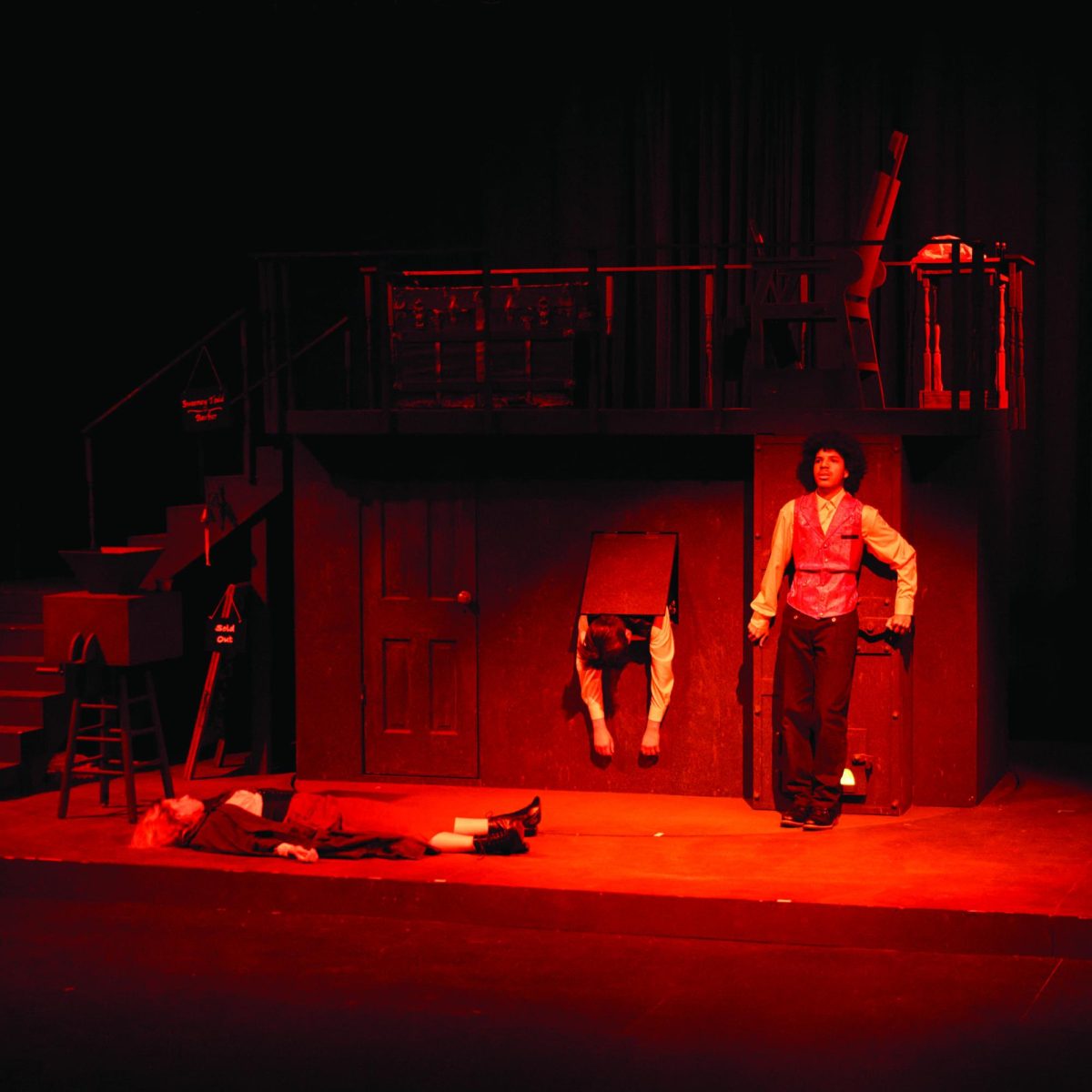
The school’s theater department premiered “Sweeney Todd: The Demon Barber of Fleet Street” on Feb. 19 , with the cast running two more performances during the weekend to great acclaim.
The production, a four-month undertaking by the cast, marked a significant tonal shift from the previous years’ more comedic, happy musicals. Both the Victorian-era setting and the generally darker themes led to a more moody, yet still occasionally lighthearted atmosphere.
“We had just done two comedies in past years, and so it felt like the right time for a dark musical,” Upper School Drama Director Katy Tye said. “In terms of dark musicals, oddly enough, (Sweeney Todd) is on the more appropriate side. It’s kind of a dark comedy; you have moments that you can laugh at, and then it gets dark, but the whole thing doesn’t sit in a depressing place.”
The original “Sweeney Todd: The Demon Barber of Fleet Street” production premiered in 1979 on Broadway, directed by Hal Prince with music and lyrics by Stephen Sondheim. Sondheim is famous within the musical world for his extremely challenging compositions, which the cast saw as a worthy potential challenge.
“I think the students were really itching to do something more challenging vocally,” Tye said. “This is a really difficult piece. The tempos are all over the map, and we dedicated two months solely to music work alone.”
This new musical challenge was met with tenacity by all parts of the cast. For the lead actor, junior Luke Cathey, portraying the titular Sweeney asked him to connect with the character both physically and mentally to play his role to the fullest.
“I think a lot of times we are able to watch something and be like, ‘Oh my gosh, that’s horrible. How could you do that?’” Cathey said. “And we don’t realize how close we come to being a little bit psychopathic in some of those moments.”
The process of relating to the character and finding ways to emulate the true essence of Sweeney Todd came hand-in-hand with the notorious difficulty of Sondheim’s work. The late composer’s music has been noted through the entirety of the theatrical community for its extreme complexity, from sharp tempo changes to pure song length, which can leave singers struggling to find time to breathe. Cathey highlighted how certain songs truly pushed his limits as both a singer and an actor.
“I would say the hardest part for me would definitely be ‘Epiphany,’” Cathay said. “It’s one of my songs towards the end of the second act, when Sweeney realizes that everybody either is a horrible person who deserves to die or their lives are so bad that death is better for them anyway. That song is very challenging because of how it was written. You’re watching this guy’s mind crack. And so there is a really fast tempo juxtaposed with cantabile sections where sometimes it’s kind of like rapping, just spitting off things with rapid fire. And then I have to switch immediately into a slower type of song in order to convey all the emotion.”
To Cathey, the best part of the project was trying to show the human part of the character.
“The whole point of the musical is to take this tale about this urban legend about a barber who kills people and give him a background, to humanize him and show he has experienced several injustices in his life,” Cathey said.
In order to more effectively engage with the play, the cast built and used the traditional “Sweeney Todd: The Demon Barber of Fleet Street” set, with Sweeney’s infamous barber chair placed on the second floor with a trapdoor setup that would lead it to the first floor’s meat pie shop.
“There’s a theater practitioner out there that talks about how a set should be a playground for the actors,” Tye said. “It should add to the play, and it almost needs to be a character of its own. With this play in particular, I went back and watched the original Broadway play, and we stayed fairly true to it. It’s hard imagining something like this until it’s built, but the students did a really good job with that, taking it in stride.”
The cast, a mix of students from private schools around Dallas, delivered performances for three nights, showcasing the hard work and dedication they had put into this project. Tye recalls the most rewarding part of the process being the moments immediately after the show.
“You get off of the stage and feel a rush,” Tye said. “There’s a camaraderie that comes along with that within the cast and seeing everybody bask in that joy was the most rewarding part to me.”