In a navy box tucked in the cabinet behind his desk, Headmaster David Dini keeps his cards.
Not trophies. Not collectibles.
Handwritten cards.
Notes from students and parents. Decades of people who passed through his life and thought to put something on paper before they left. He never throws them away. Every once in a while he’ll pull one out and read it.
Dini knows what a letter can do, how powerful simple words on paper can be. So when the opportunity came to send some to children in Ukraine, he didn’t hesitate.
In March, students across multiple Middle School humanities classes wrote letters to children affected by four years of ongoing war in Ukraine, part of an effort organized through trustee Kathy Crow and the Olena Zelenska Foundation, a nonprofit run by Ukraine’s first lady dedicated to the welfare of children displaced or harmed by the conflict.
It came together in eight days. The story begins in Washington.
In late March, first lady Olena Zelenska traveled to the United States to participate in a global summit on children’s welfare, education and technology. During her visit, she spoke of a resilience story: that even as Russian missiles had dismantled Ukraine’s physical infrastructure, the country had built digital platforms powerful enough to keep its children in school — children who spend a significant part of their day underground in a bunker but still can log on, attend class and learn.
Zelenska and her foundation believe that even in the middle of war, children deserve an education, a sense of normalcy and the feeling that someone beyond their borders knows who they are and cares about them. She describes the foundation’s mission in three words: help life win.
From Washington, Zelenska traveled to Dallas for a private meeting with George W. Bush. The Bush center reached out to Crow to ask if she would host a gathering at Old Parkland — a meeting of roughly 100 civic and business leaders who would hear directly from the first lady about her foundation’s work.
Crow agreed. And then, with a little more than a week and a visit from a wartime first lady on the horizon, she started thinking about what to give someone like Zelenska to thank her — something that would reflect what Zelenska cared about most.
Crow thought of the children in Ukraine. Then she thought of the boys in the Lower, Middle and Upper School.
“I reached out during spring break, not really sure if anything could come together that quickly,” Crow said.
A couple of days later, Dini called back with the letters ready.
Across Ukraine, the children the foundation serves live in a reality most Marksmen will never encounter.
A typical day, according to Viktoria Romanova, CEO of the Oleana Zelenska Foundation, bears little resemblance to one in Dallas. Air raid sirens interrupting classes are a common occurrence in many regions. When the sirens sound, children stop whatever they are doing and go to shelters. For many, this cycle has become routine — not an emergency, just an accepted part of the day.
Many children have been displaced from their homes entirely, continuing their education remotely from cities far from where they used to be. The physical markers of a normal childhood have, for most, simply disappeared.
“Despite all of this, they keep studying, making friends, laughing, and dreaming,” Romanova said. “Most importantly, many of them see their future in Ukraine.”
The foundation works to make that future possible. It equips schools with bomb shelters, provides devices for remote education and runs a network of “12-21” youth spaces, open environments where teenagers can spend time, connect with others and receive support from professionals. Its focus, Romanova says, is on restoring something the war has tried to take: a sense of normal life.
When Zelenska spoke in Dallas, she didn’t come with a list of specific requests. What she came with was a refusal. A refusal to allow the world to grow numb to what was happening. A refusal to let the world get used to the war.
That refusal stayed with Crow long after the event ended.
Fifth grade Humanities teacher Eric Slingerland heard about the project through Head of Middle School Dean Clayman: Crow was meeting with Zelenska, and she wanted his students to write letters to children in Ukraine. Slingerland didn’t hesitate.
“It was a wonderful opportunity for our students to make a meaningful difference in someone’s life,” Slingerland said. “(To make a difference for) people that they’ve never met from very different cultures, who have been going through a difficult time.”
Because of the subject, there were some guidelines and high expectations for the letters.
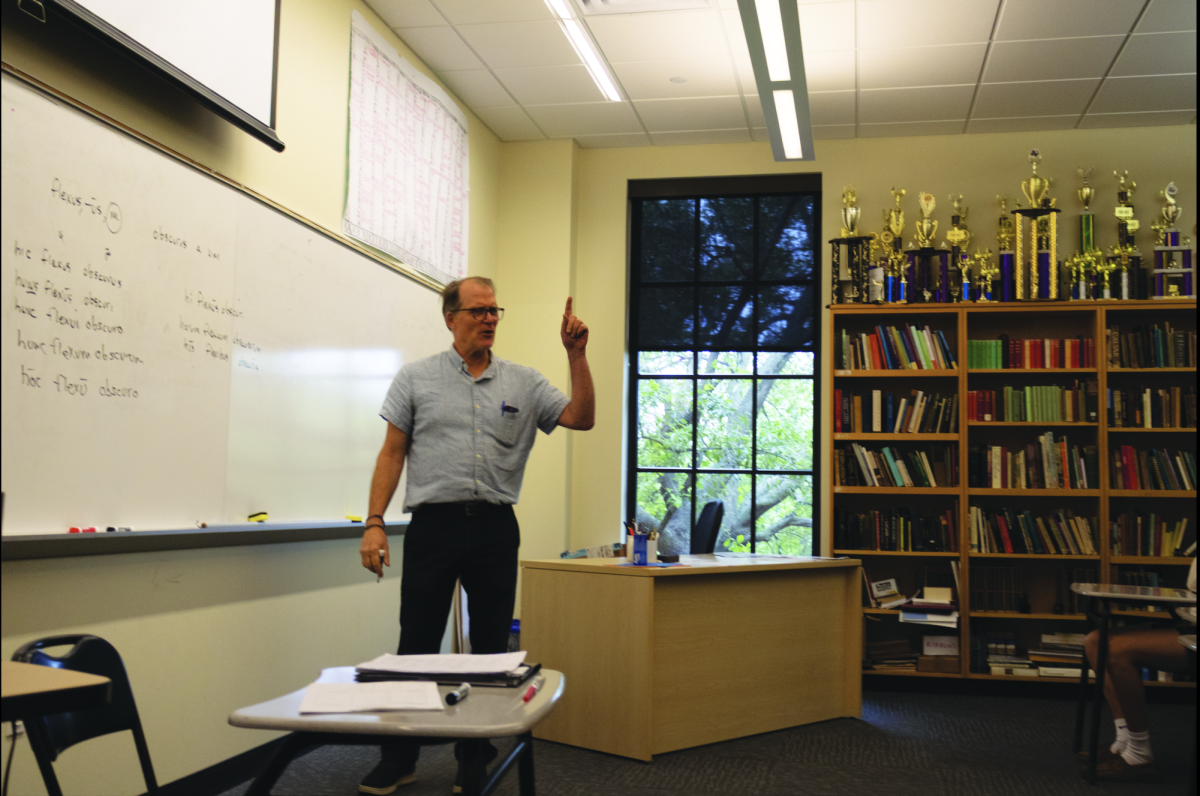
Slingerland projected his own letter on the screen before his students began theirs. He wanted to show them how someone navigates a near-impossible task: offering support without assuming understanding and reaching across an ocean without pretending to know what’s on the other side.
His guidance was simple. Be clear, be kind, don’t assign blame and don’t say you know what they’re going through, because you don’t. And write neatly.
“Simple messages can be powerful,” Slingerland said. “It’s just about conveying that we care about the people in Ukraine.”
The letters that they wrote were exactly what Slingerland had hoped for: thoughtful, kind and considerate.
Two common themes emerged across the letters. The first was hope: an encouragement to keep going, a reminder that even when things are hard, they can get better. The second was presence: the message that there are people in the United States who are thinking about you, even if they have never met you and probably never will.
One student quoted a Bible passage. A prayer, Slingerland thought, that someone on the other end could say when things got hard. He read every single one before they went out.
Crow read them too. She went through the bundle before the gathering at Old Parkland.
She saw the blue and yellow drawings, the hearts, the flags. She read the boys writing about their own lives before reaching toward something they couldn’t fully imagine.
“You could just feel that our Marksmen understood, in their own way, that something very serious was happening,” Crow said. “They wanted to reach out and show they cared despite the distance.”
When Zelenska arrived, Crow handed her the bundle. The First Lady was moved. There was, Crow says, a humility and gratitude in how she received them that made the moment feel larger than the room it happened in.
“In that moment, it became clear that something simple and sincere—a collection of letters from young students in Dallas—could carry real emotional weight across the world,” Crow said.
Zelenska told Crow she would distribute the letters to schools her foundation supports, specifically to children in Kharkiv, a frontline city that happens to be Dallas’ sister city in Ukraine. In Romanova’s words, it is a place where air raid sirens can sound several times a day, and at the same time, people continue to study, work and dream.
For Dini, the project was never just about Ukraine.
It was about what happens when a boy has to think outside of himself, to sit down and reckon with the fact that the world goes beyond just him, his friends and his school. It was about showing him that halfway across the world, a kid his age is navigating through something he can’t imagine.
It was about teaching him that his couple dozen words will matter to that kid in ways he’ll never see.
“You don’t know how your words will be received,” Dini said. “What you say can have an enormous impact on someone’s life, long after they’re said.”
He has evidence of that, sitting in a navy box in the cabinet behind his desk.
The letters are currently being prepared for delivery to Kharkiv. Crow and her husband are traveling to Ukraine in early May to visit one of the schools the foundation supports, and if things go as planned, to meet some of the children who received them. When the letters arrive, Romanova says, the effect will be difficult to describe but easy to feel.
“It feels like a small miracle,” Romanova said. “It is as if someone far away thought about you and reached out. In that moment, the distance simply disappears.”
The boy who wrote his letter in March may not have known if it would ever arrive.
But soon, he will find out.
His letter from Kharkiv arrived in Dallas, and a friend he has never met before has written him back across the same ocean.