
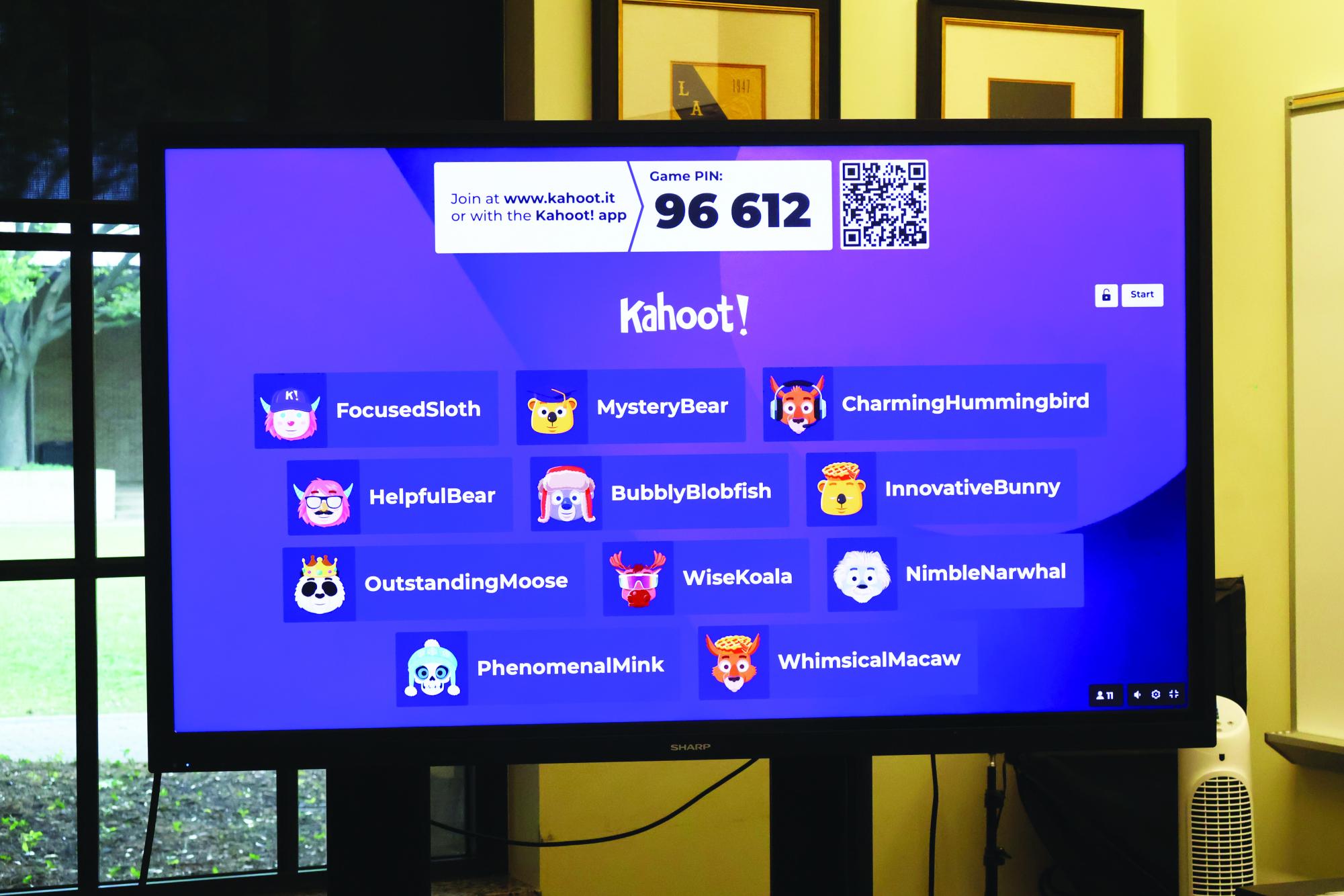
Usually, you’re not supposed to play games at school. But for some reason, almost all students know the thrill of winning a Kahoot in class.
Because while older generations may not be familiar with the use of games in the classroom, for current students in grades ranging from elementary to high school, the use of games for learning is almost ubiquitous. Everyone has participated in a game-based activity in class, especially in younger grades.
The use of games in education to increase student engagement has seen an increase in popularity among teachers, and nowadays they are commonplace in middle school classrooms and can even be found in the Upper School. Teachers across the country have turned toward a style of teaching that involves more game-based learning.
Many educators find games to be a useful tool in the classroom to help with learning, especially when introducing new vocabulary or concepts that need repetition in order to be committed to memory.
“I think (games) are really good as a way of getting kids to learn terminology and facts that they will then need to use in the day-to-day and on tests and quizzes,” biology teacher Dan Lipin said. “It’s fun, and kids get animated.”
The diversity of options teachers have for implementing games in their teaching allows for significant flexibility and choice. In general, games can be applicable for various subjects, ranging from language and the humanities to STEM.
“Some of the games I use I have created myself,” J.J. Connolly Master Teaching Chair Nancy Marmion said. “Others I have learned from other teachers or they are games that are real life games, like a board game or something, that I’ve converted to using in the classroom.”
Teachers can use many different kinds of games in many different ways to try to reach their unique objectives, allowing them to be useful for various classes and levels of difficulty.
“I think creating games is possible in all classes,” Lipin said. “I would make board games, and I’ve seen games used in any subject. Firstly, any subject has facts that you need to know in order to help you. So any subject could use games just to help kids learn the basics. And then secondly, you can develop all kinds of games to help someone learn the interactions between concepts.”
In general, there has been an increase in the use of games in classrooms as teachers search for ways to increase student engagement. With increases in accessibility, more and more teachers have introduced game-based learning methods in their teaching.
“There’s definitely something that I think has changed in education, probably in part because of the prevalence of games in society for young people — from video games to different types of (other) things,” Marmion said. “I think that’s one of the reasons that teachers in multiple disciplines have started using more games — because kids are more used to being entertained.”
The main issue teachers deal with when implementing games is the tradeoff between engagement or fun and productivity. Although games -boost entertainment in the classroom, they can also prevent students from diligently reviewing and internalizing the material.
“A negative of (games), which we have to be careful about, is that sometimes the students are not actually learning what you want them to learn,” Lipin said. “There are certain games that I try to steer away from where they have to answer questions in order to get points to do the game, and they’ll end up not answering the questions and just playing the game.”
Lipin also cautions students against using in-game performance as an indicator for how well they’ll do on actual tests or assessments. Classes and lectures often examine concepts and ideas in much more depth than his games, which only serve as quick overviews of units.
“The other problem I found is that kids will memorize all the answers,” Lipin said. “So there’s a question with words, and then there are the answer choices with a bunch of words, and so are the students learning the (information), or are they just learning which words to click? I’ve had to encourage my students to not just rely on the game, like, ‘You have to use the Kahoot! to know what you don’t know and then do your own studying based on the game.’”
Technology has also affected how games are used in the classroom, as web-based games like Kahoot!, Gimkit, Blooket and others are popular among students and teachers alike. For teachers, the internet has also increased the accessibility and ease of finding games to use, likely increasing the prevalence of the game-based learning phenomenon as well. However, some teachers may shy away from overusing technology-based games because they could also prove to be more distracting to the students.
“There’s certain games that are easier to make because of technology,” Marmion said. “I (also) think there’s a point at which I want to get away from the screen-based games too. I think some of them are fine, like Kahoot!. But I think there’s also a lot to be said for other types of games that aren’t necessarily screen-based, because we have so many screens in our lives. I think you can still have classroom games that don’t do that and can be effective as well.”
Overall, game-based learning has seen a general increase in classrooms around the country as teachers aim to liven up the atmosphere and improve engagement. With technology and the internet making educational games more widely available, this trend seems likely to continue spreading.