Turning invasive species into stylish leather and selling it to the fashion industry is a unique way to do business. But it’s one of the sustainable ways that INVERSA deals with invasive species issue.
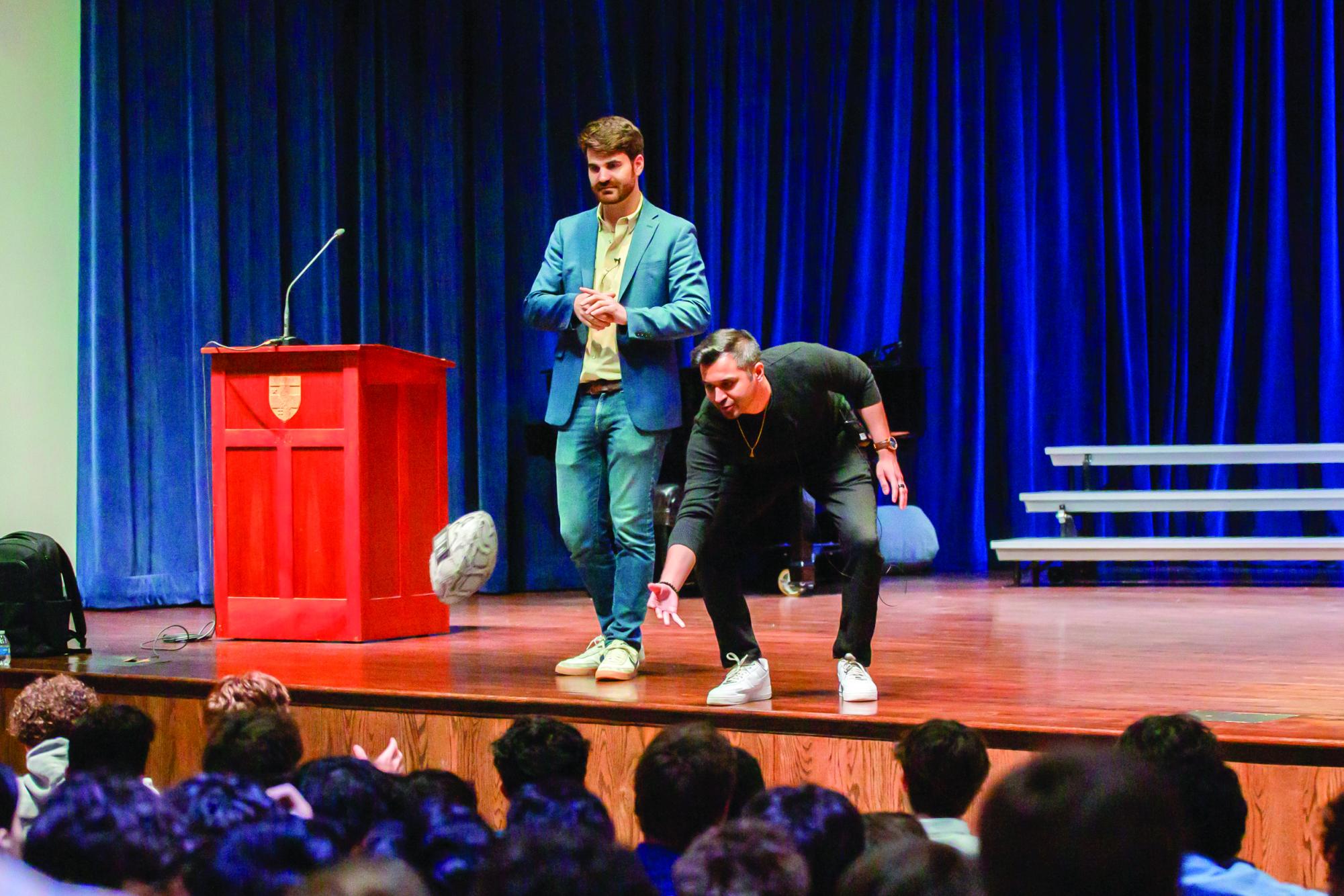
Two co-founders of INVERSA, Kahan Chavda ’12 and Roland Salatino ’12, visited the school on Friday, Feb. 27, for the annual 2026 STEM Conference. During Upper School Assembly, they spoke about their experiences creating their startup and the lessons they learned. In addition, students were able to see and touch products made out of INVERSA leather that were handed out, such as baseballs and footballs with unique patterning.
Based in Florida, INVERSA is an ecosystem restoration company that handles invasive species in various innovative ways. The company interacts with the private sector when they turn the skin of some of the invasive animals they exterminate into leather and sell it to the fashion industry, where there is a demand for items like handbags made out of silverfish leather. They also contract with local and state governments to use their technology to handle invasive species.
“By creating these public-private partnerships with governments at state, federal, local levels, we’re able to remove invasives en masse from where they don’t belong,” Chavda said. “By taking some invasives, turning them into leather and finding a way to commercialize the biomass — in this case, selling the leather to the luxury European fashion (industry) — we take those euros of demand for this luxury product and we funnel it straight into ecosystem and restoration efforts as well as job creation.”
In 2020, together with fellow Marksman and eventual CEO Aarav Chavda ’13, Kahan’s younger brother, the three alumni founded their company. Inspired by their experiences as scuba divers and their love for nature, they decided to try to eliminate the issue of invasive species.
“We started because the three of us are scuba divers,” Salatino said. “We’d seen the lionfish; That was the first invasive species that started this whole idea of ‘There’s gotta be some way to defeat these things.’”
Kahan and Salatino both started at St. Mark’s in fourth grade, and they have been lifelong friends ever since. They credit their experiences at the school with shaping their values and providing them with vital connections. After graduating, Kahan and Salatino went to different colleges. Yet, they stayed in touch and reconnected when they became roommates for a few years living in Chicago.
“St. Mark’s not only allowed us to build who we are, but it also surrounded us with incredible people who really changed the course of our lives,” Salatino said.
For Eugene McDermott Master Teaching Chair in Science John Mead, who taught Kahan and Salatino in 6th-grade life science, watching his past students blend science with entrepreneurship has been especially rewarding.
“(INVERSA) is a great example of people who are taking what they learned in a science class and applying it in a job that has a great science impact but also goes beyond science,” Mead said. “It’s really neat to see that you can be successful in the world thanks to your science knowledge, even if you are not a traditional lab coat scientist.”
Mead, who also serves as the faculty sponsor of the STEM Conference, added that INVERSA’s unique initiative extends beyond the science classroom, helping raise overall environmental awareness in everyday life.
“I’m excited that they’re taking this topic and helping make the general public more aware of things through their fashion choices,” Mead said. “It’s a great way to get adults who aren’t necessarily tied into, say, invasive species, to become more aware of them.”
The two friends had discussed starting a company for many years, even during their time at the school, but they had never really seriously considered pursuing that seemingly implausible idea. In 2020, however, Kahan and Salatino decided to finally give it a shot. The pair recounted taking a month of unpaid leave from their respective jobs to pursue their company. If by the end of the month, it didn’t work out, they would go back to their normal lives.
“We took, at the time, the biggest risk of our lives, the biggest leap of faith,” Kahan said. “It was our confidence in ourselves and each other, and our ability to not just see the dream, but to execute and to build with it (that helped us survive).”
Fortunately, when the time came, they were happy with their progress, and they continued pursuing their startup ambitions. But even then, they were walking on eggshells every day, fighting to keep their startup dream alive and trying to find the right direction for themselves.
“It was also exhilarating,” Salatino said. “We had no illusions about the idea, the fact that as a startup, especially a young startup, every day could be the last one.”
Now, more than five years after its founding, INVERSA has 10 employees and has expanded its operations across the country, even adding some programs abroad. Recently, the company passed the mark of 2.6 billion animals saved through their efforts in reducing invasive species, and they aim to continue sustainably addressing the issue of invasive species and bettering the environment.
“It truly feels like that for the past five years we’ve been experimenting, we’ve been iterating, and I think we figured out how to make it work,” Kahan said. “And now we’re just trying to scale and build it.”