
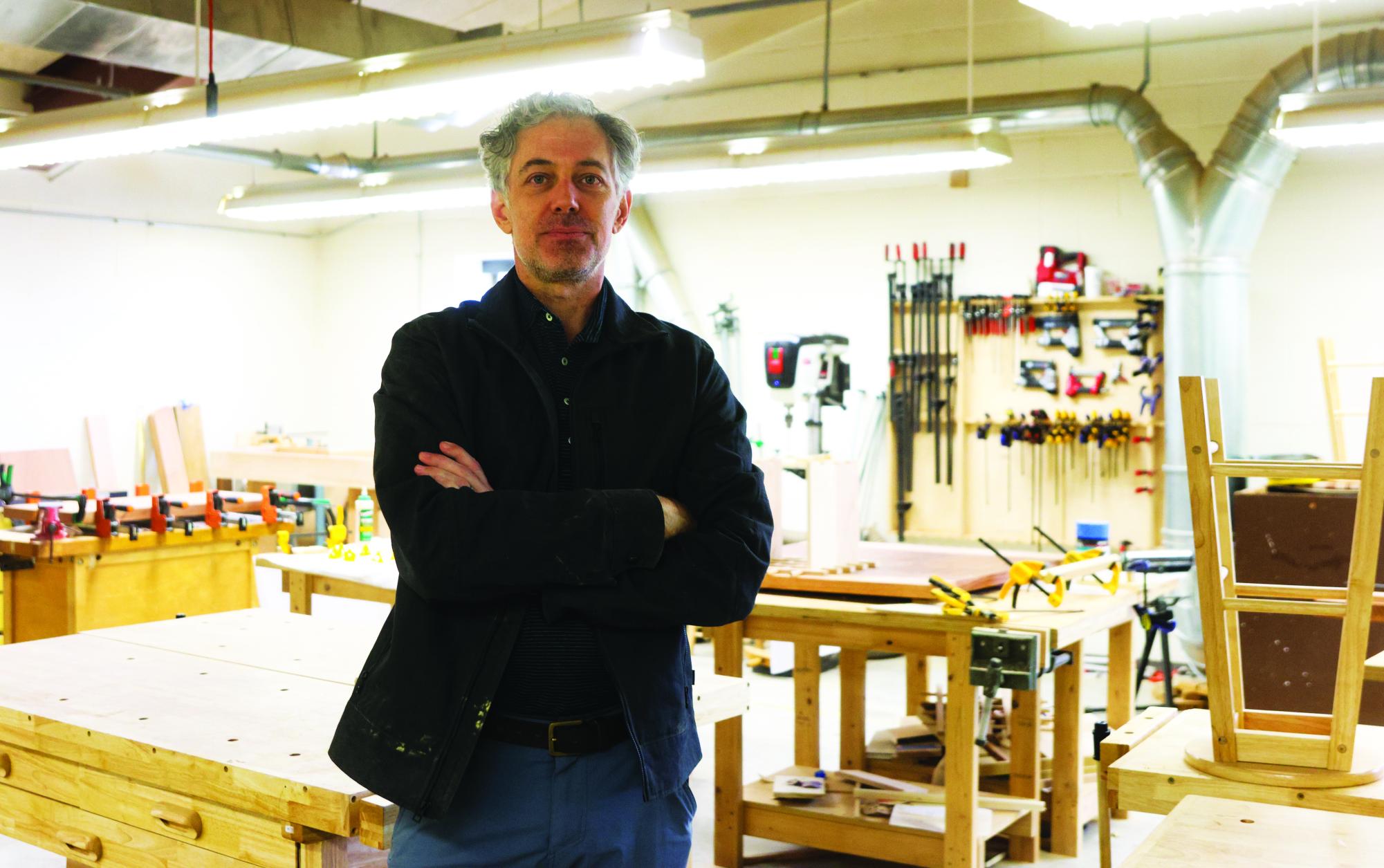
Growing up in Roswell, New Mexico, a town better known for its UFO lore than its fine arts, taught Ryder Richards that he couldn’t always trust the official story. That he shouldn’t accept a widely held belief without thinking it over himself. Today, that same suspicion of easy narratives rubs off and bleeds into his art and his philosophies.
As a teen, Richards went to Roswell High School, a 4A school with around 5000 students, where he played football, basketball and baseball. Later, in his junior year, he moved to Lubbock, Texas and began attending Lubbock Christian High School, a much smaller school with about 200 students.
“(Sports) definitely did (influence my art),” Richards said. “I think there’s a lot to do with understanding your role within a group and how teams function, also how individuals function within group structures, you could call those societal structures.”
After high school, Richards went to Texas A&M to study architecture, but then ended up attending Texas Tech with an undergraduate degree in painting. For his masters degree, Richards went to TCU, where most of his pieces were painted sculptures.
“(In college) I made several trips to Europe to study things like color theory, drawing and watercolor. My first job in Dallas was running the art galleries for Richland College and after running their galleries for three years, I took a year to go to New Mexico and did nothing but make art for a year at a residency,” Richards said. “After that, I came back and taught college a little bit more, and then went into the corporate world for almost 10 years, where I was a creative director.”
Ryder’s passion for art stemmed from his childhood, long before he reached architecture lectures and painting programs. His mom was also an artist who actively brought drawing into his life, and it quickly became a natural hobby for him.
“I have been drawing since I was 3 years old, as soon as I could pick up something and scribble,” Richards said. “I had a notebook that had all these drawings I had made during church. So one of the ways my mom kept me quiet during church was by letting me draw.”
While he started off drawing, Richards eventually transitioned more into traditional woodworking, which is primarily what he does at the school. Now he teaches more concepts that are embedded within the work, including skill building and designing unique, functional art.
“My dad always said you had to play a sport or have a job, so during the summers, when I wasn’t playing sports, I had to have a job. I got a job as a carpenter at a cabinet shop,” Richards said. “So it was in my junior year of high school that I started doing woodworking, and I’ve been doing it ever since.”
From his previous endeavors in sports and art, Richards believes that in the workshop, you don’t have to put a ton of pressure on yourself. In his opinion, art can serve as an outlet for relaxation and creativity without significant stress.
“Sports is often all about being in a moment. You can practice forever, but on the day of the tournament or the game, you have to perform at an excellent level. And I think with art it requires a lot more pondering and thinking, rather than just a small moment of execution. Art is a long term execution. You build skills over your lifetime.”
Unlike the high pressure situations that sports place on athletes, art provides a stark contrast that has a far more patient nature. In the workshop, success is often marked through slow refinement and persistence.
“(What) I like about art and woodcraft in general, is that you’re usually doing it alone and you don’t have to show the piece to anybody. No one’s really viewing you or watching you make it. You have this chance to work harder and harder and longer and longer hours to make that thing better and better.”
Richards has leaned more and more into doing woodworking as a form of art, not doing it as a job, but as a type of therapy.
“I find the longevity of it quite appealing, that you could be an old man woodworker, just like you could be an old man golfer,” Richards said.
Richards joined the school as the wood and metal teacher starting in the 2025-26 school year, and his impact on the community has been enormous.
“I think he’s a great teacher and knows a lot about what he does,” Sophomore Jesús Serrato said. “Any problem I face, he helps me solve it but also while helping me learn something new and useful.”