A father holds his young son at the Colorado Springs airport, about to board a returning holiday flight. The baby does what many babies do — looks around at the people nearby, raises a small hand and waits for someone to wave back.
Nobody does. They’re all too busy looking at their phones.
English teacher Cameron Hillier ’13 watches his son’s gaze and waving hand meander around the gate and finds himself having what he can only describe as an out-of-body moment. Hundreds of people, not one of them looking up.
Across the gate, two kindergarten-age girls sit next to their father — eyes glazed staring down at their iPads, headphones covering their ears and their dad scrolling beside them.A family that doesn’t talk to each other. Hillier doesn’t say anything. He just watches his son keep waving at the wall of unresponsive travelers.
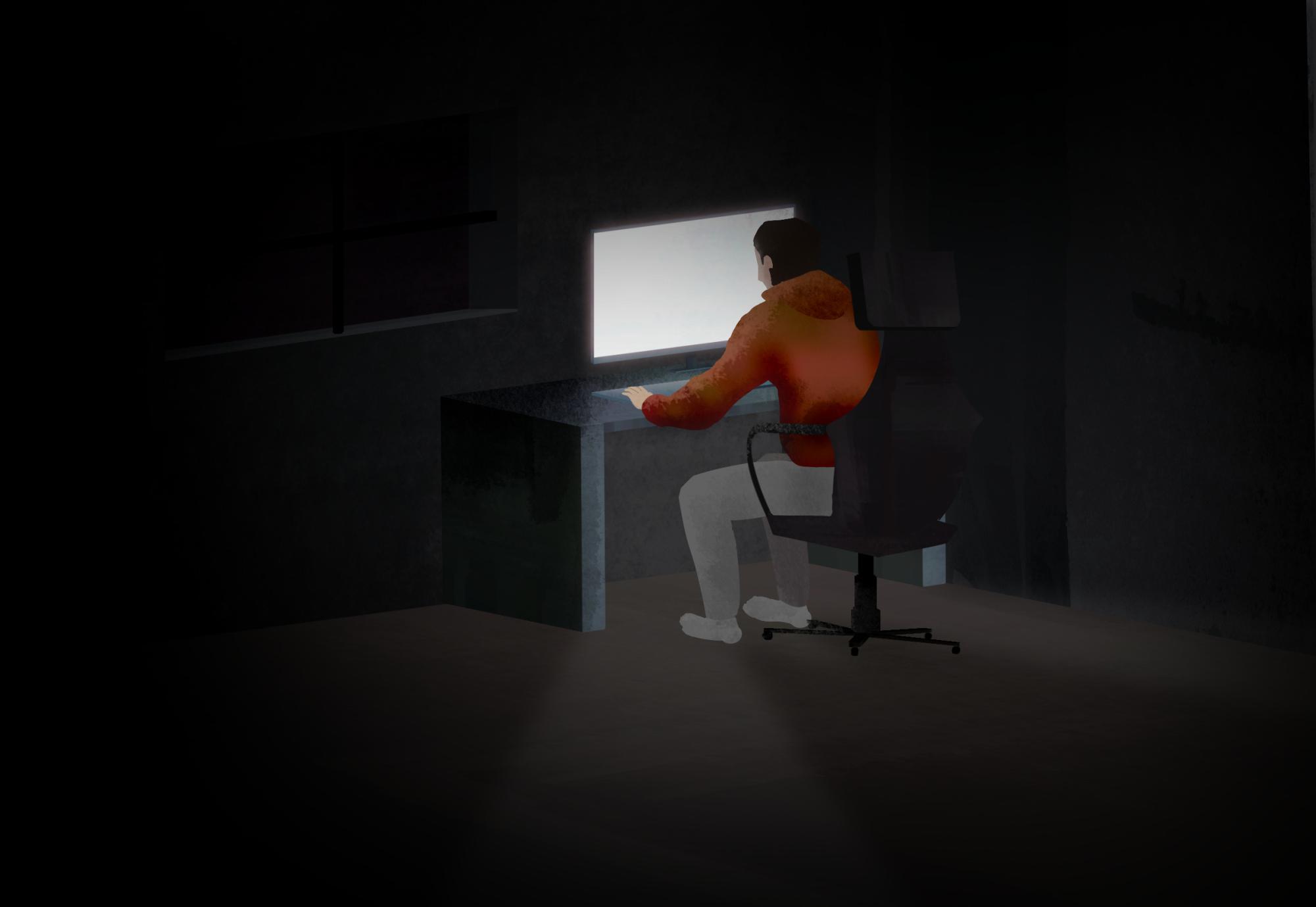
It isn’t just the airport. It’s the senior lounge, the passing period, the dinner table, the waiting room — every moment that used to be empty is now filled.
For Hillier, the phone has quietly colonized the spaces where nothing used to happen. What’s disappearing inside that emptiness is something that hasn’t been named yet.
Not just time. It’s boredom itself.
For history and social sciences teacher Dr. Jerusha Westbury, boredom has a definition most people expect.
“Boredom is not knowing what to do with yourself,” Westbury said. “It’s that feeling of whatever is on the table, whatever lies in front of you, just being completely unappealing.”
That restless, uncomfortable feeling, she argues, is not a problem to be solved. It’s the point.
“That (moment) is when you start daydreaming,” Westbury said. “It’s when you start picking up stuff to do. It’s when you start figuring out who you are.”
She has watched that process get harder to find. Not just in her students, but in herself too. At home, Westbury juggles mundane housework, class preparations and grading. A single mother, she also has to take care of her son.
There often just isn’t enough time to do it all at the same time — so the TV goes on in the background. Not because she wants her son to watch it but because it gives her a little bit more time to do everything else.
“I think our ability to handle boredom is dramatically declining,” Westbury said. “Everybody has to be constantly entertained. There’s not a lot of downtime to spend with yourself.”
What worries Westbury most is what might potentially be lost with boredom.
“Boredom tells you who you are,” she said. “Boredom opens doors. Boredom is where creativity happens.”
Dr. Reed Robinson, a clinical psychologist and associate professor of psychiatry at UT Southwestern, spends his days treating patients whose relationship with being uncomfortable, being bored, has broken down entirely. What Westbury describes philosophically, he sees in clinical form: people who have spent so long escaping uncomfortable feelings that they’ve lost the ability to navigate them at all.
According to Robinson, nobody has managed to prove Westbury’s connection. However, he’ll say this: the time boredom used to occupy was spent doing something real.
“Having learned experiences with how you can spend time with yourself without these other things can be really helpful in terms of boosting a sense of resiliency and self-sufficiency,” Robinson said.
Without boredom and the opportunity to face discomfort, teens will lose the time to develop either.
Every semester, Hillier’s dystopian literature course opens with the same exercise. Students track their own screen time for a week and report back. The average, across five years of seniors, has never fallen below 35 hours. Some students clock 50.
He doesn’t wag his finger at them. He just wants them to look at the number and ask themselves a question.
“If you’re on your phone seven hours a day for seven straight days, that’s the single most used thing in your life,” Hillier said. “More than sleeping. More than school. More than being with your friends.”
The effect, he argues, isn’t just the hours. It’s what the hours replace. His seniors, according to Hillier, can’t fathom reading for fun.
“On any given day, you walk into the senior lounge, and everybody’s on their phone,” Hillier said. “Ten dudes sitting in there, every single one on his phone.”
Nobody talking. Nobody bored enough to start a conversation.
He asks his students to name three TikToks or reels they can remember from a week of watching. They can usually name only one.
“It’s a black hole,” Hillier said. “Things just disappear.”
Robinson has a theory behind that black hole. The phone, he explains, has been deliberately engineered to deliver dopamine — the same neurological transmitter that makes other things addictive. The difference is availability. The device’s ability to so effectively engage while remaining accesible is what makes is so powerful.
Robinson argues that the consequences of that deliberate engineering run much deeper than lost hours, drawing a comparison that might sound extreme at a surface level. He argues that breaking a phone dependency operates similarly to quitting highly-addictive medications like Xanax.
“The same withdrawal, in a probably less potent form, can happen with people when they try to break themselves off from using their phones,” Robinson said.
The result, for heavy users who try to cut back, is a period of increased discomfort.
“You end up with increased feelings of emptiness, declining self-esteem and reductions in actual productivity,” Robinson said. “There’s no fulfillment typically to be had from that type of dopamine farming.”
In the Centennial building, Hillier has been watching that downward spiral play out for five years. For the first few years that he ran his screen time exercise, his students denied feeling addicted.
Thirty-five, 40, sometimes 50 hours a week on their phones. And students still confidently denied the possibility of an addiction.
Then, about two or three years into teaching the course, the denials stopped. Students started acknowledging the habit, acknowledging what it probably was, but the acknowledgement came with a shrug.
“They would say, ‘Yeah, I’m addicted,’” Hillier said. “‘And I’m good with it. It’s just normal. We all are.’”
Hillier found that more unsettling than the denial. At least denial meant the behavior was still considered a problem. To him, part of what makes it so hard to dislodge is that phone addiction occupies a category entirely its own.
While every other addiction carries a stigma, having a phone and social media is an obligation.
“If you don’t have Snapchat, if you’re not part of that ‘group snap,’ you’re weird,” Hillier said. “You’re out of the loop.”
And underneath the social pressure is something simpler and harder to argue with — the phone is just accessible. Everything on it is designed to be fun, frictionless, instantly gratifying in a way that almost nothing else in life is.
Even so, what some of his students tell him stays with him.
“I’ve had more than a handful of students say (that they) don’t want to be alone with (their) thoughts,” Hillier said. “(They) want to distract (themselves).”
Every spring, though, Hillier sees the same realization dawn upon seniors.
As April rolls in and graduation gets close, students who have spent four years moving too fast to look up suddenly start looking around. Hillier has watched it happen enough times to expect it — the moment when the number on the digital screen time report starts to connect to real-world consequences.
“A lot of guys get pretty introspective naturally,” Hillier said. “They ask themselves, ‘Man, I really spent this much of my life on my phone. Could I have been doing something else?’”
It’s a question Hillier argues arrives about four years too late.
According to Hillier, nobody ever liked being bored. Kids before smartphones didn’t love having nothing to do either.
“It was more like, okay, how are you going to fill that time?” Hillier said. “And it seemed the ways one filled that time were generally healthier.”
Westbury’s concerns run deeper than habit and delve into development. It’s the question of what gets built — or doesn’t get built — in years of phone-filled moments when boredom once did its quiet work. The moments where she believes we develop identity, creativity and the ability to sit alone in a room without feeling unbearably uncomfortable.
“I’m a little worried about the day when somebody doesn’t know how to be alone with themselves at all,” Westbury said.
Robinson sees the same thing from a clinical angle.
He traces part of it back to something with good intentions, to what seems like good parenting.
“As parents shield their children from distress, they are moving forward into life with less capacity for resiliency, more vulnerability to depression and anxiety and more vulnerability to having difficulties that they feel underequipped to navigate,” Robinson said.
According to Robinson, this stance represents the widespread social belief that a child experiencing discomfort means a parent has failed. The result is a generation with a specific and compounding disadvantage.
“The danger is a generation with a lack of experience with navigating discomfort at all,” Robinson said.
Robinson’s answer to the obvious question, what to do with that time, doesn’t start with a solution. His answer starts with a reframe. Like Hillier, Robinson believes the goal was never to get good at being bored.
“Boredom is not a destination,” Robinson said. “Boredom is an obstacle.”
Rather, the goal is to stop running away from boredom, to stop turning away from the opportunities boredom provides.
“Very few people just want to pass the time as comfortably as possible,” Robinson said. “Most of us have other things we want — and making progress towards those things means encountering boredom as you challenge yourself.”
Not avoiding it. Engaging through it.
Hillier’s son is still young. He hasn’t learned yet that most people won’t look up.
For now, he’ll just keep waving.