
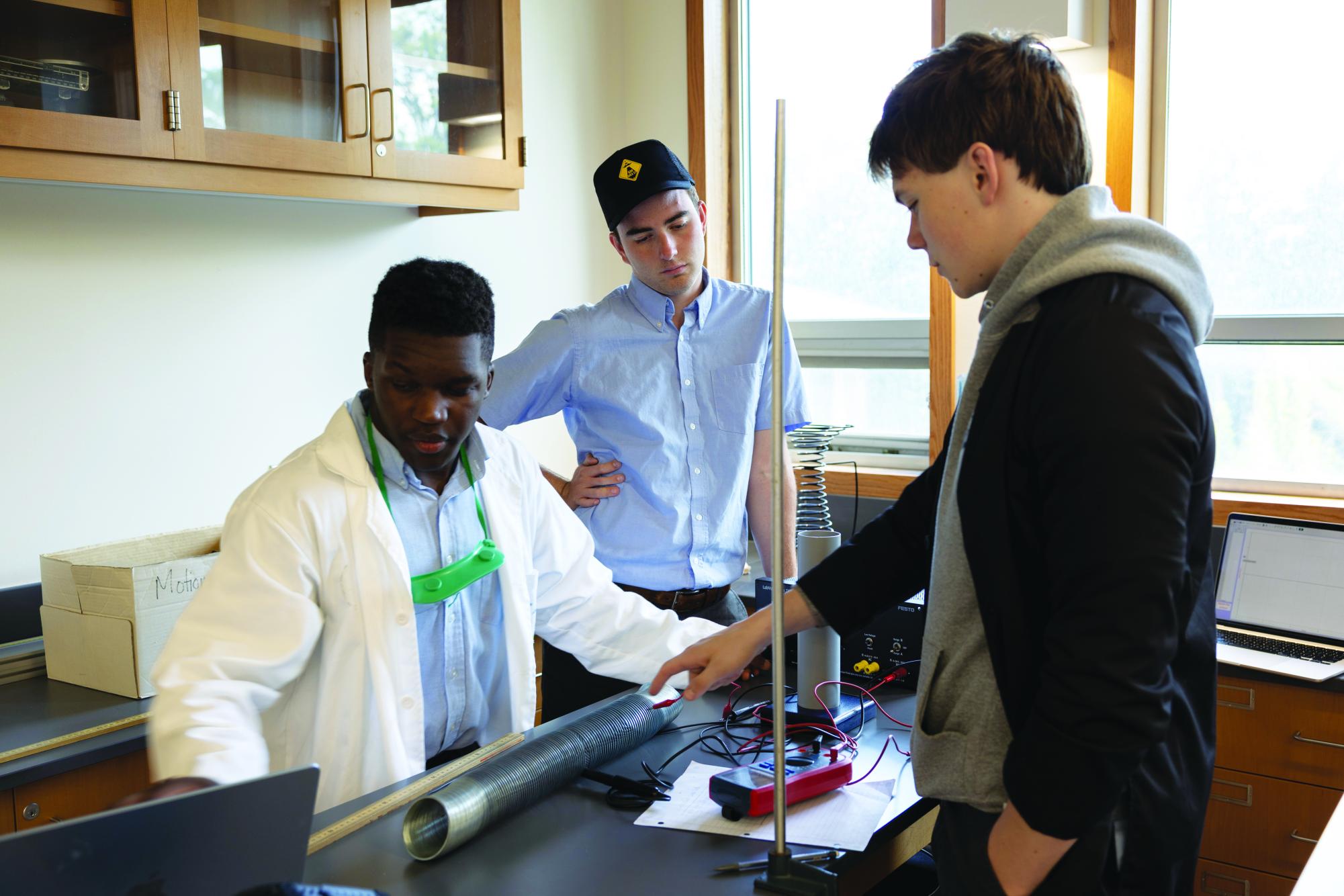
In the classes within the secluded alcove of the Winn Science Center, the often mundane-seeming activities of laboratories serve as true reminders of the privileges presented within the school.
All Upper School students must take at least three science classes as part of their graduation requirements, and labs are worked into all possible science courses that a student could take. From reactions in chemistry to splicing in DNA Science, students are provided a wide variety of hands-on learning experiences. For Cecil H. and Ida Green Master Teaching Chair in Science Mark Adame, the sheer quality and quantity of the provided equipment is staggering.
“We have autoclaves, we have sterilizers, tissue culture hoods, ultra freezers, normal freezers, thermocyclers, sets of laptops, electronic balances and, of course, the pipette gear,” Adame said. “I have students come back and say that this is better than college.”
It’s not just the equipment that Adame says is helping, but rather the real-life experience students can get from working in hands-on, technical environments, which he believes grants an edge in those tasks later on. He also highlights how these opportunities are few and far between for most public school students.
“We’re fortunate to be able to get (the equipment) in the first place and not have to scrounge for things like I’ve done in the past,” Adame said. “(The kids) get to see the technology, and if they do go into the life science field, they’ll definitely see it again. (Learning how to use equipment) makes them stand out in their class, their labs and classes in college… I think that although there’s a steep learning curve, once they get (the skill), they’ll never forget it. So I’ve had too many kids come back and say, ‘Oh, I had to show everybody how to use the pipettes. Or had to show everybody how to pour plates, or show everybody how to make a gel.’”
It is this very mentality, that the best way to learn or understand a concept is through doing it, that permeates through the science department. Allowing students to do the activities themselves not only gives them freedom to learn, but also creates practices of curiosity in learning. Cecil and Ida Green Master Teaching Chair Ken Owens ’89, incorporates this mentality into his labs.
“Students need to see the chemistry for themselves.” Owens said. ‘Even demonstrations are not enough. A demonstration that is not explained is just theater. They also need to learn physical skills, manipulation of beakers and burettes and the equipment — how to build their apparatus, how to use their apparatus. I have kept a lot of older classical gear like the large burettes instead of doing titrations with eye droppers, because I think working with real equipment is more meaningful and provides a better educational experience. It’s not true everywhere.”
Working in labs also provides a platform for students to gauge what they really want to focus on, even if they realize that the hard sciences might not be for them. For the department, it is not about forcing them to love labs, but rather teaching them to use their skills to solve new kinds of problems.
“Labs are helpful because you actually do stuff with your hands instead of just using your brain all the time.” physics teacher Stephen Houpt said. “In general, it’s a good thing to know how to think and problem-solve whether you’re going to use it or not. Now, do I, for instance, think that knowing how to do Precalculus is going to be helpful for somebody that’s a history major? No, but I think it’s about learning how to think.”
The lessons imparted within what may seem mundane is a core part of what Owens teaches, and he hopes that doing labs is just a small part of building up the whole man.
“You have to be a good citizen coming out of an education, not just good at science, not just good at history, not just good at math.” Owens said. “We do not ask you to learn all of these different subjects so you can forget them as soon as you get your diploma. You may come here thinking that you are going to be a chemist and find out you don’t like it. That’s valuable information for you to have. You may come here thinking you want to do history and find out that as a serious student, it’s not for you. That’s valuable information.”