
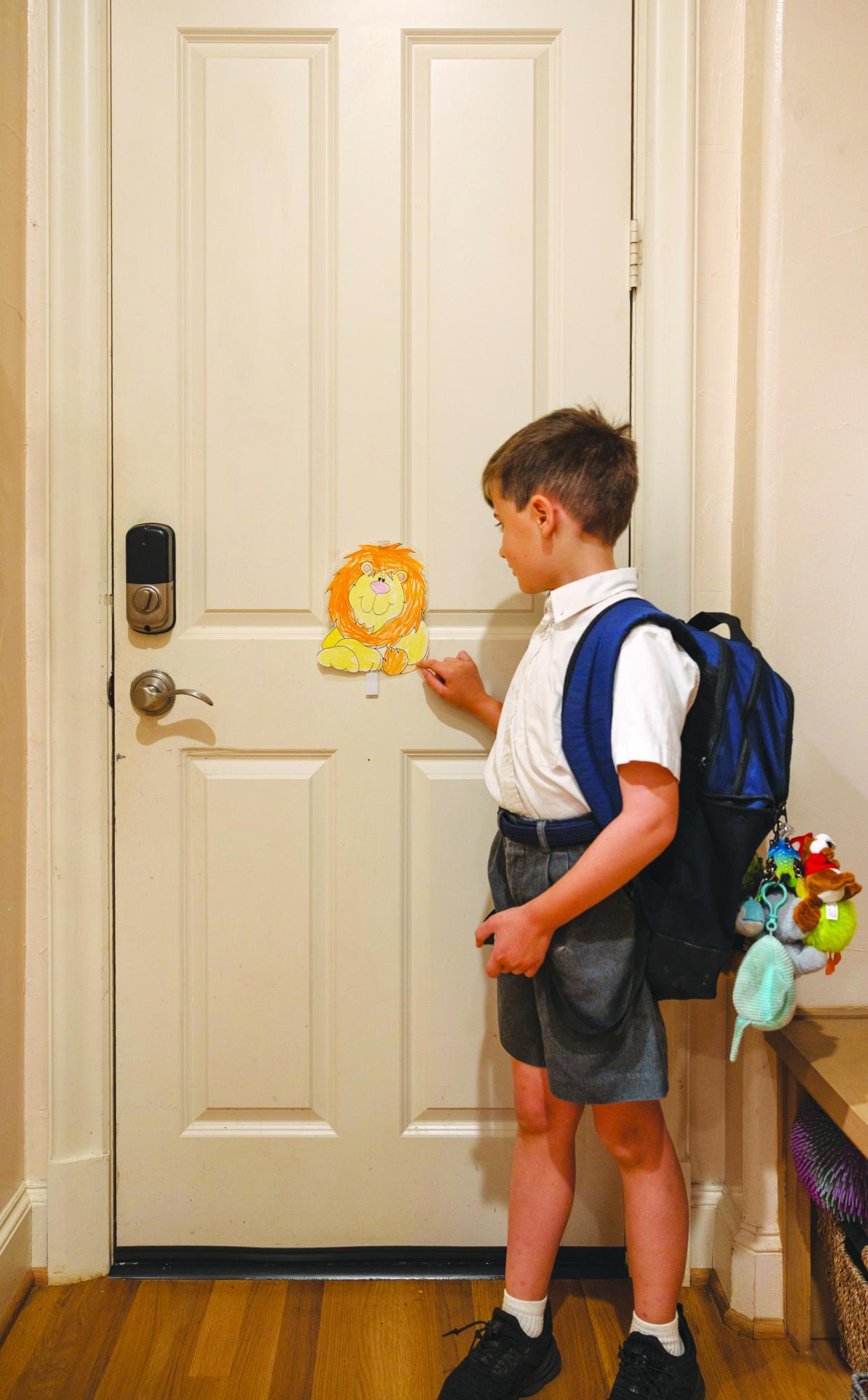
On the first day of school, before anyone has learned anyone else’s name, First Grade Teacher Teri Broom lays something out on every desk.
It’s a black-and-white outline of a lion. Nothing special to look at yet — just lines on a page, waiting. Broom tells the boys to color it as neatly as they can, and puts her own example up on the document camera so they know what they’re working toward. They pull out their colored pencils and get to work.
They don’t know what it’s for yet.
By the end of the day, or the next morning at the latest, the lions come back laminated. Attached to each is a small sheet of paper explaining the rules and giving it a name: Checkpoint Charlie. And from that point forward, it goes home with every boy and lives there to hang by the door, at eye level, at the last place a boy passes before he walks out into the world.
The rule is simple: touch it before he leaves, and when he does, to ask himself just one question.
Does he have everything he needs?
Broom has been teaching first grade at the school for two decades. She didn’t invent Checkpoint Charlie — the tradition predates her, and its exact origins have blurred with time — but she has carried it forward with the conviction of someone who has seen it work too many times to doubt it.
“For the boys who actually use it, it really does help,” Broom said.
The need for something like Checkpoint Charlie, she explains, is visible from the first day. The school draws first graders from many different schools, many different homes and, most importantly, many different levels of readiness. Some boys arrive already independent. Others are still being dressed by their parents in the morning. All of them are about to be handed a binder, a homework routine and a set of daily expectations that have no equivalent in kindergarten.
Checkpoint Charlie is not a solution to all of life’s organizational challenges, but it is a starting point — a physical object that stands in for a habit that hasn’t formed yet, a way of asking a question until the question becomes ingrained.
“It’s really about just creating responsibility in them,” Broom said.
Broom is deliberate about the coloring exercise, about the fact that the boys make it themselves, on the first day, before they know what it means. By the time they understand the rule, the lion is already there to support them.
Hilton Sampson ’25 graduated from the school last spring. He is studying at the University of Texas at Austin, navigating finals and midterms and the general machinery of a life managed without anyone managing it for you.
He still does the checklist.
Not with a lion — he doesn’t have one anymore, hasn’t for years. But the mental version of it, the habit of standing at the door and running through what he needs before he walks out, stayed. He traces it back, without hesitation, to first grade.
“I remember in first grade we were given those Checkpoint Charlie lions,” Sampson said. “I had it hung up in my garage door, and every day before we would go to school, I would touch it and make sure I had everything I needed.”
Earlier during the spring semester, he had a management information systems final. He was allowed to bring notes — a printed study guide he’d been going over for days. He was heading out the door when the mental checklist caught it. The study guide was still on his desk.
He turned around and grabbed it before leaving.
“I think that having that obviously helped me do better on the final,” Sampson said.
For Sampson, the habit was the point, not the study guide. Moving into college, he immediately noticed he seemed more prepared than some of his classmates. Not just with the right materials, but in a broader sense — ready to take on whatever the day required.
“It’s not just the physical things you want to remember,” Sampson said. “It’s planning out in your head your entire day and making sure that you can show up, ready to go at every step along the way. Starting it when you’re young helps prepare you to be responsible and manage your activities wisely.”
He said if he had kids someday, he’d want something like it for them too. To start the habit early, to give it a shape and then let them make it their own.
Broom has seen it work in her own sons. Both went through the school, and the habits followed both of them out. She’s seen the habits in the boys who come back to visit, who still greet her properly, who know how to sit at a table with adults and hold a conversation.
Broom remembers a valedictorian who reflected on Checkpoint Charlie in front of the whole school in 2021. He talked about how being responsible at 6 years old, not just told to be responsible but given a tool and a routine and a reason, compounded and echoed time and again as he approached his senior year.
The lion on the wall is, in that sense, not really just about remembering what’s in the backpack.
It’s about what happens when a boy learns, early enough that it becomes instinct, that the day goes better when you stop at the door and ask yourself if you’re ready; that the small moments of intentionality — a hand on a laminated lion, a pause before the garage — can be the difference between showing up and showing up prepared.
It’s the first step out the door and onto the long journey to independence.
“Even though I don’t have the same physical aspect of it now, the idea of it has kind of stuck with me,” Sampson said.
On the first day of first grade, Broom will put a black-and-white outline of a lion on every desk. Later that day, a boy will sit down for the first time and do his best to scribble within the lines. And by the time that boy is grown, he might not be able to tell you exactly when his habits formed. But he’ll have them.