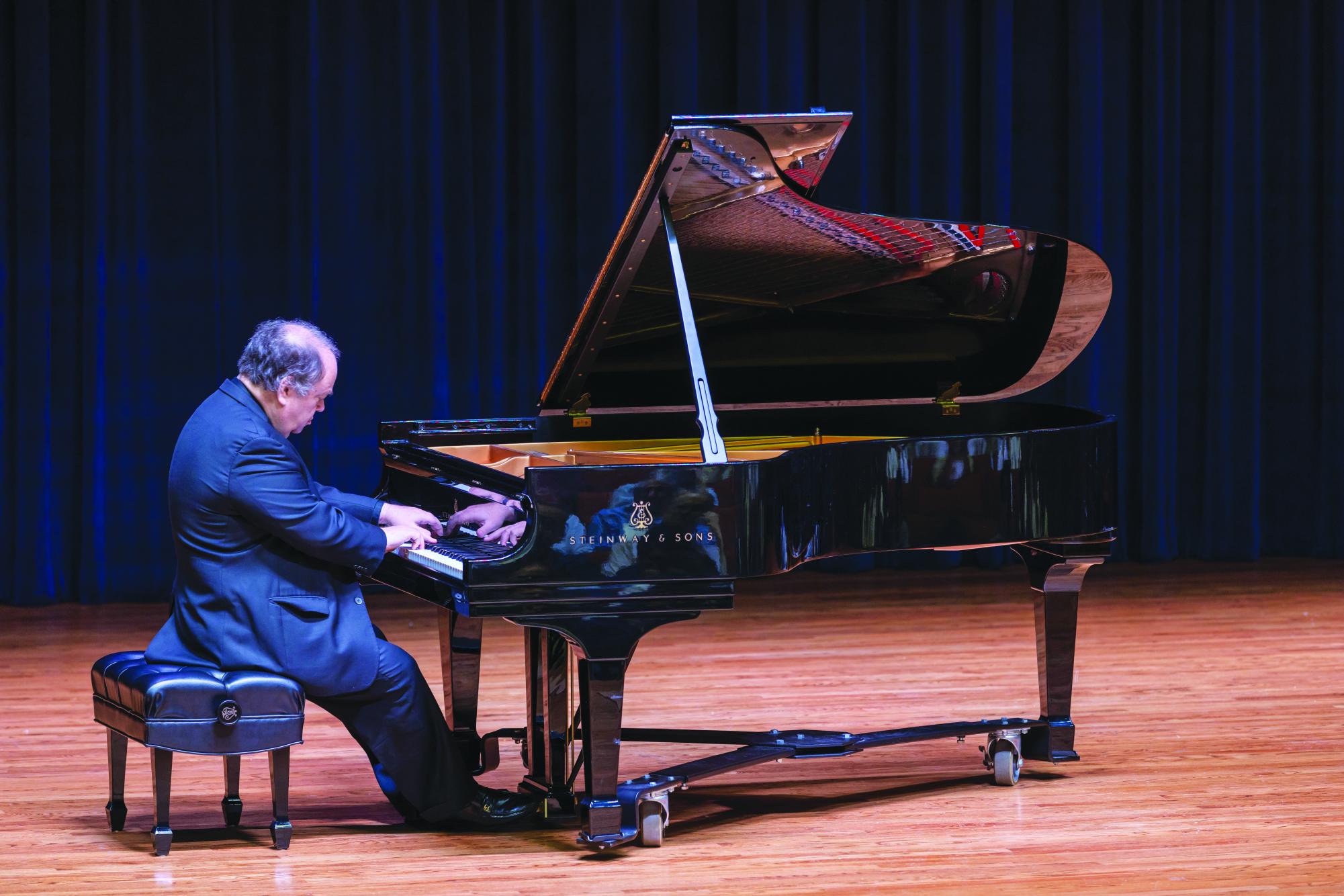
Starting in eighth grade, Jeffrey Swann ’69 left his host family on Norway Road each morning to reach school before the rest of the campus woke up. Because at 5:30 a.m., the chapel — home to the school’s best Steinway piano — was his.
Then began his daily routine: practice before his first class, sprint between classes to the piano the moment each period ended. On most days, if not all, he skipped the cafeteria entirely. Lunch was practice time. Every free minute he possessed was directecd towards to his obsession with music.
And once his school day ended, he still found himself sitting on the piano bench, hunched over a keyboard. Sleep was scarce, but he wasn’t assigned this schedule. None of it was required by anyone but himself.
“If I had been in New York or Vienna or London or Berlin, there would have been structure,” Swann said. “There would have been other people around me doing the same thing. I would have done this with other people.
Whereas, as a kid growing up in Dallas, it was just me. I developed this very monastic, rigorous lifestyle.”
While his methodical discipline toward mastering the keys relied heavily on his own work ethic, it wasn’t without guidance. Outside of school, Swann studied composition and conducting at SMU under Alexander Uninsky, winner of the 1932 Chopin Piano Competition. Uninsky also helped find sponsors for Swann’s room and board in Dallas.
It was Uninsky who taught him how to treat every performance opportunity. Whether it was an in-home concert in front of his patrons or a performance in front of hundreds, it had to be with the same intent.
“There’s no such thing as important and unimportant concerts,” Swann said. “Ultimately, when you play a concert, you’re playing for that one person whose life you might transform or give to. Every single time, you play with all your heart.”
But the hours Swann poured into his mastery of the piano left little to no room for much else. No other extracurriculars, no relationships — his schedule simply didn’t leave space for either. And without the typical high school experience as his classmates, he was forced to sacrifice the traditional teenage experience to continue his work and passions.
“Because I was so incredibly invested in music, I had very, very few friends in the class,” Swann said. “I was friendly with three or four kids, but not close.”
Still, for Swann, the sacrifice was all necessary to achieve his purpose. Because his mother was a musician, Swann had been surrounded by music his entire life. There wasn’t a moment when it transferred from a hobby to his calling. Becoming a concert pianist always seemed like his natural path.
“If people were to ask me when I decided to become a musician, it’d be like saying when I decided to have brown hair or brown eyes,” Swann said. “It’s just who I am. There was never anything else I had ever considered.”
Even though his music journey seemed inevitable, the extent of what he gave up for it wasn’t. Looking back, he believes the sacrifices were just too great.
“I don’t advise people to give up everything to the extent that I did,” Swann said. “I don’t think it was healthy. It was necessary for me because I had to justify getting up at 4:30 every day and doing all this stuff. I justified it by saying I was an artist. But at the same time, you’re only young once.”
In his eyes, the most important consideration is that for those who wish to focus their life on the fine arts, it has to be because they have such a deep love of it that they can’t imagine life without it.
“I think people decide too soon what they’re going to do with their lives, but in the classical music world, people have to do that,” Swann said. “That’s why there’s such a deep commitment but also a great vulnerability.”
As he’s gained experience and maturity, Swann’s outlook on music has changed. Now, what matters most to him is the love behind every piece, the passion that can’t be communicated through inked notes on a page. It goes beyond the complex polyrhythms and chords that dance across dozens of keys.
“As I’ve gotten older, I, more and more, think that a good concert is good not because it’s played at such an extremely high professional level but because it’s played with the right spirit of love and enthusiasm,” Swann said. “A technically very flawed performance of the Eroica (symphony) by a youth orchestra might have more in the real spirit of music than a very slick but boring performance by the New York Philharmonic.”
Today, Swann is working on a new Beethoven concert cycle. The repertoire is inexhaustible — in his mind, he could live ten lifetimes and still not scratch the surface.
During his practice times, he still spends hours sitting alone in front of his piano in New York City to figure out the smallest details, but that’s okay with him.
Because music has always been a part of who Swann is.
Even decades after those early mornings in the chapel, Swann still loves everything music has given him and everything he has given it. And as long as he can, Swann will continue playing, fulfilling the hopes of that same kid.