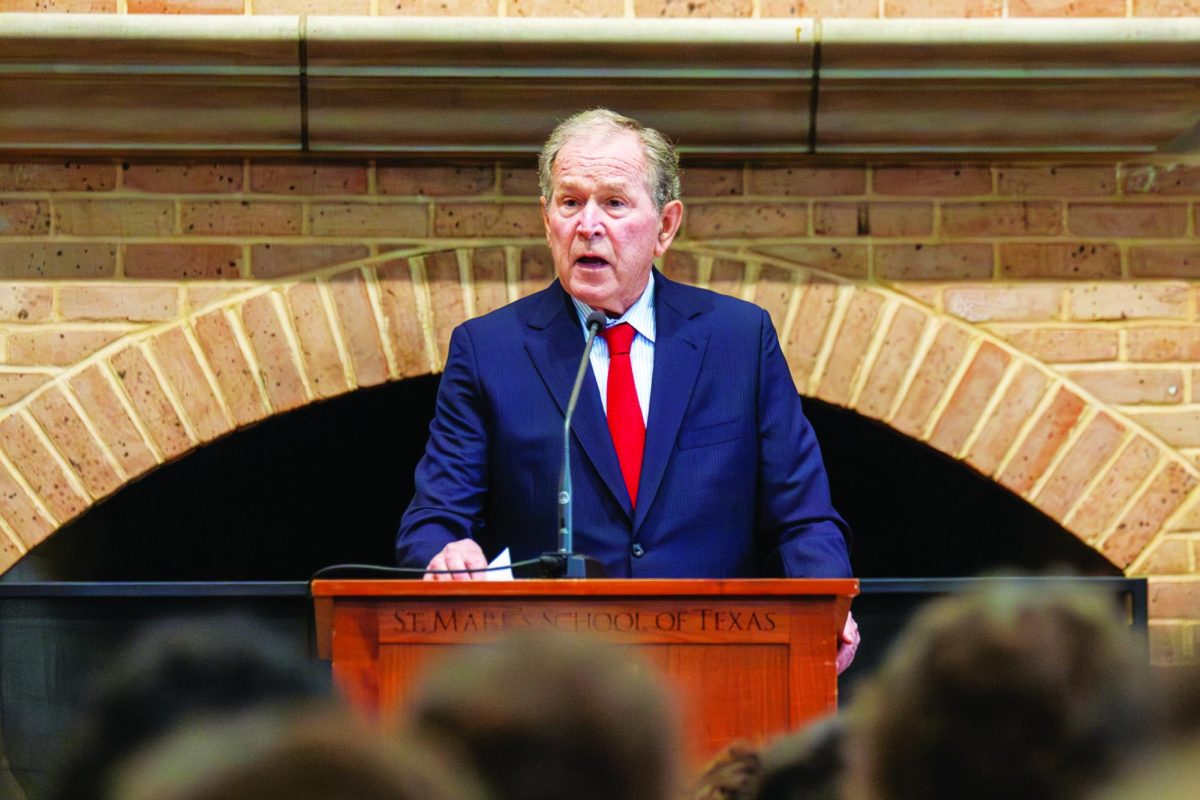
On the morning of April 21, the Great Hall hushed as Headmaster David Dini approached the podium. Most students assumed it was the standard convocation speech — looking ahead to the last quarter, urging them to finish the year strong.
Then the side door opened, and a crew of personal security ushered the 43rd President of the United States, George W. Bush, through the side doors of the Great Hall.
Met with a standing ovation, Bush’s presence captivated students and faculty as he delivered a speech celebrating the nation’s 250th anniversary. He talked about George Washington. He talked about humility. But one line echoed throughout campus long after he left.
“I will always be honored to carry this title that means more to me than any other — Citizen of the United States,” Bush said.
Not Governor of Texas, Fighter Pilot or even President, but a title that many take for granted: Citizen of the United States. But that title can only mean something if people embrace it.
Amidst the winks and subtle jokes, his underlying message left students reflecting on their responsibilities: as stewards of 10600, as “soldiers fighting in the armies of compassion” and as citizens of the country.
For many, Bush’s speech was not just a celebration, but also a reminder. A reminder that, without consistent engagement, the values that have shaped our country for 250 years can feel overlooked.
Two hundred and fifty years is a long time for an idea to survive. The American republic was founded upon a revolutionary one: that the government derives its power from the people, that citizens are not subjects, and that the whole system depends on ordinary people upholding a social contract.
This social contract ensures an interdependence between the nation and its people. It requires citizens to prioritize the well-being of their communities over personal incentives. Dr. Andrea Hamilton, who teaches U.S. history at the school, put it plainly.
“Citizenship implies being willing to act, not just out of self-interest, but for the good of the whole,” Hamilton said.
But the fragility of the contract, she explained, was the central preoccupation of the founders. They knew their idea could only survive with a virtuous, educated and committed citizenry. A republic, they understood, is only as strong as the people running it. And they rarely lasted.
Bush reiterated that same notion, 250 years later, to a room full of teenagers. The question the speech left hanging in the air was whether that idea still holds. Whether, in 2026, the average American wants to be a citizen or something closer to a spectator.
Eager to exercise their new privileges, Marksmen over 18 hold an optimistic view of their ability to vote. For senior Diego Armendariz, the importance of civic participation has been ingrained in him from a young age.
“My parents have always emphasized voting regardless of your political ideas,” Armendariz said. “Because it’s important to get your voice heard. It’s a feature of our American democracy.”
Armendariz acknowledges that, although one vote may seem insignificant, the collective impact of votes can be substantial. And even though the outcome may not necessarily reflect his personal views, Armendariz recognizes that the act of voting itself upholds the foundational principles that bind the republic together.
“I realize my vote probably doesn’t mean that much, but I think that’s such a bad mindset to have because the world is made up of individual people,” Armendariz said. “If everybody thought like that, then nobody would vote, and nobody would get their voice heard.”
Similarly, senior and Executive Student Council President Adam Dalrymple believes that active participation in communities is what keeps those communities alive. Dalrymple doesn’t just limit these values of giving back to voting; rather, he continually applies them in a more immediate environment: the school.
“What makes St. Mark’s special is the drive the students have to make an impact,” Dalrymple said. “Whether that be journalism, Student Council, telos or basically any club, students try their very hardest to make an impact, move the school forward and uplift their community.”
However, this desire to make a difference doesn’t come without responsibility. In a world where non-credible sources are available and even promoted, Dalrymple knows how big a role education plays in responsible participation.
“(Education) is a top priority for me,” Dalrymple said. “I need to know what I’m voting for before I actually vote — all the details, the reasoning and understanding both sides of the issue. That’s extremely important.”
Despite their optimism, both seniors can’t help but feel anxious. With their new right to vote, they now feel the weight and tension of political polarization firsthand, and are wary of making a considerate decision.
“I think our country’s situation is pretty awful, including the rhetoric from both sides,” Armendariz said. “It’s become less about actually discussing ideas of how to help our country and more about attacking people who disagree with you.”
Armendariz doesn’t usually encounter this discouraging rhetoric in classroom discussion, but rather on his phone. He notices that when behind a screen, people are provided with an anonymity that makes them feel immune to scrutiny or judgment, only amplifying political boldness and extremes.
Not only does social media allow for shameless expression, but it also separates people into factions — factions of belief that are reinforced and held together through repeated exposure.
People can find communities online where everyone is in unanimous agreement. When exposed to the same opinions over and over again, citizens lack the ability to discuss issues civilly, much less listen to opposing viewpoints.
For young voters who receive information from non-news sources like social media, the opportunity to form beliefs individually wanes quickly. Dr. Jerusha Westbury, who teaches upper school history and AP U.S. Government, warns of the danger of blind faith in information procured from the internet.
“You’re taking what’s coming out of an influencer’s mouth as the gospel,” Westbury said. “That’s concerning.”
This biased form of political discussion not only creates an unhealthy environment but also makes participation seem less appealing, deterring eager voters from their responsibilities. Even so, rather than encourage voter education, social media platforms often feed viewers with videos of similar stances or even clips to the detriment of an opposing view.
“The criticism used to be differences between platforms,” Westbury said. “But now, criticisms have turned to morality — where people view the other party as being fundamentally immoral, as opposed to having a fundamentally different approach to solving economic issues.”
Dalrymple and Westbury believe that the anger incited by social media’s barrage of different ideas is what creates the most polarization. It drives some people to extremes and others — those stuck in the middle — to feel isolated and unrepresented.
Some citizens buy into the online activism. Others disassociate from politics entirely.
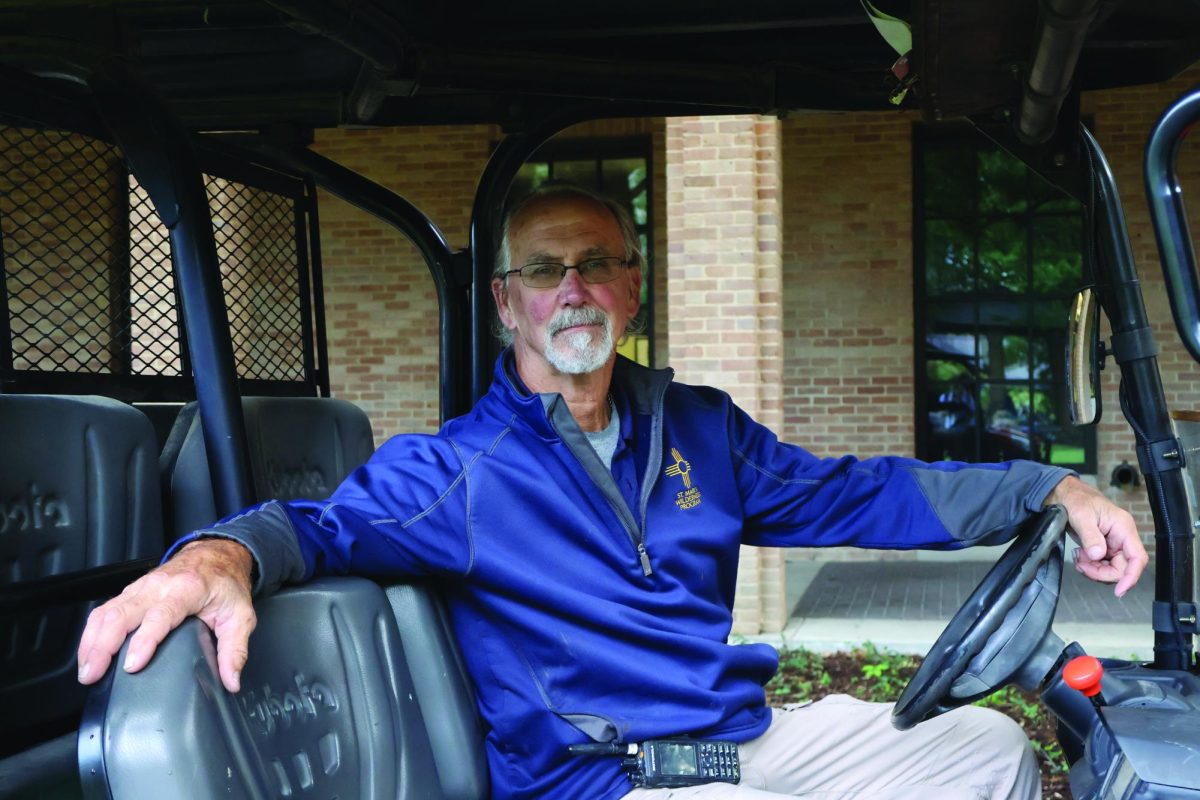
Edwin Rodriguez is an Alto driver in Dallas. He was born in Brooklyn, raised in Williamsburg and is Puerto Rican by heritage. He drove to Dallas to continue raising his child.
Rodriguez has voted once in his life. He was young, he says, and didn’t know how the world worked yet. His community told him a candidate was good for the neighborhood, and went and voted for that person without really knowing why. He has not voted since.
“Sometimes I just think the right to vote — they gave us that right to make it feel like we got the right to vote,” Rodriguez said. “But at the end of the day, I feel like it’s all lies. It’s really what (those in power) want.”
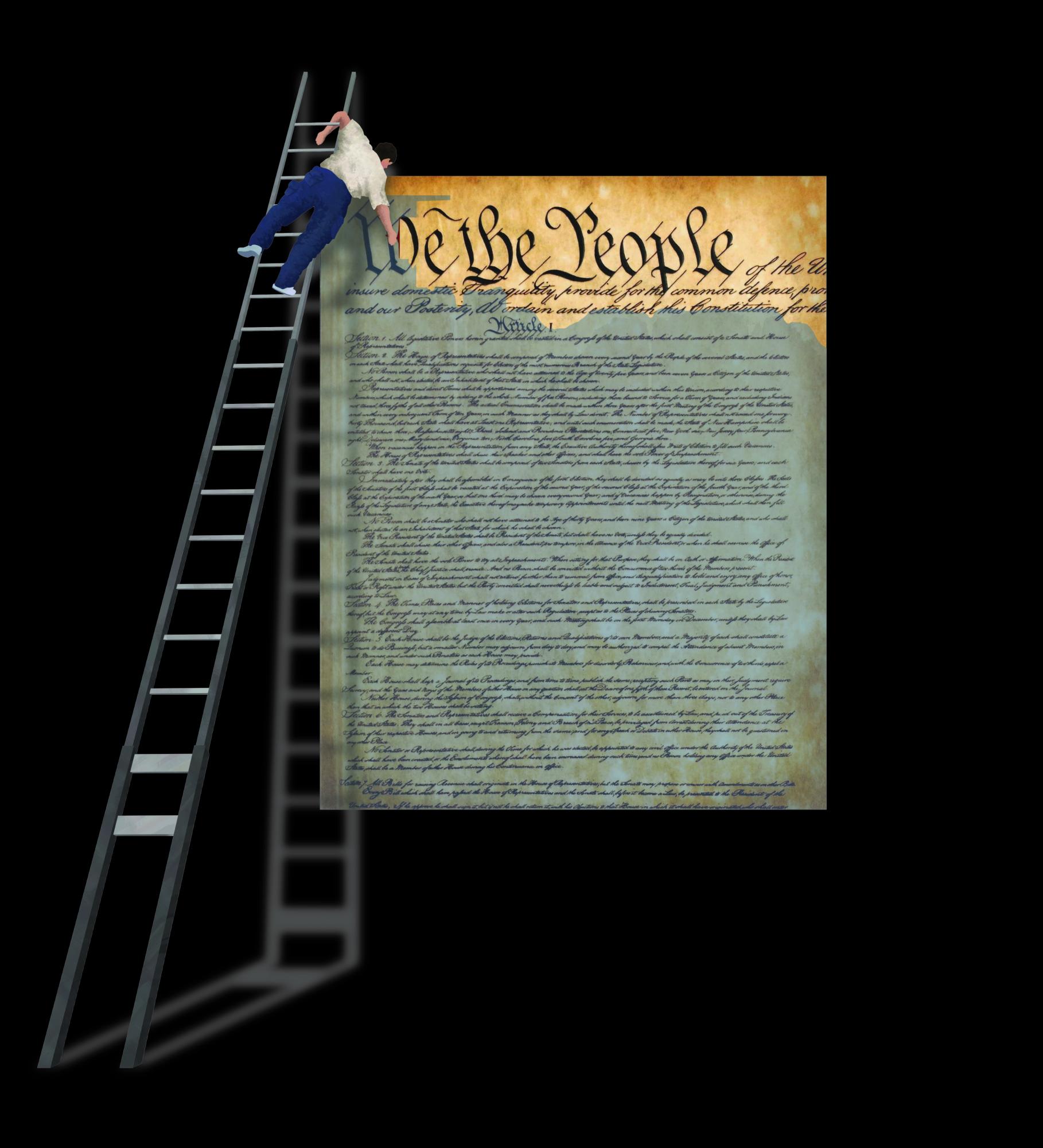
He is not apathetic. Rodriguez wants to believe in the idea of collective power. He wants to believe in community. He wants to believe in the phrase “we the people.” But he thinks that the system’s promises are empty.
“Our country was founded on those exact words,” Rodriguez said. “We the People. The words are there. But the people are not there. The people are falling behind. That’s what’s happening in this country.”
Rodriguez’s belief is symbolic of the crisis of trust that has festered over the past several decades — not just a lack of trust for the other party, but in the system itself. According to Hamilton, it’s the result of the sense that the American Dream was no longer feasible.
But that distrust is dangerous, Hamilton says — it’s a line that should not be crossed.
“Once people show that you can get away with not trusting the system, who’s ever going to go back and trust it?” Hamilton said. “I think that the U.S. will continue as a country. It’s just — will it be a democracy in the same way? I think maybe not.”
Yet even as trust erodes, Westbury sees something that hasn’t changed.
“No one wants everybody else’s life to be miserable,” Westbury said. “Almost everybody wants things to be better. They just have different ideas about what’s wrong.”
That distinction of disagreeing on solutions, not intentions, is one that Westbury believes has quietly disappeared from public discourse. She remembers a time when political disagreement felt different — less like a verdict on the other party’s character and more like a debate on the best route to the same destinations.
“Everyone kind of shared the same set of facts. And rather than presenting and arguing about different issues entirely, it was more, ‘How can we solve this?’” Westbury said. “And the solutions were different, but the problem was the same.”
Westbury argues that the reframing is where the work has to start. Not with grand gestures or sweeping policy, but in the simpler and harder act of assuming that the person on the other side of the argument isn’t the enemy.
It doesn’t resolve the polarization. It doesn’t fix the system Rodriguez no longer believes in. But it creates the conditions where civil discourse is possible, the foundation upon which the republic was built.
For Headmaster David Dini, Bush’s visit was both a historic occasion and a confirmation of something the school has always tried to teach.
“The speech aligned with our values and the school’s mission and our devotion to character and leadership development, cultivating positive virtues and habits,” Dini said. “Things like humility and dedication and sacrifice and service. It was an expression of humanity.”
That humanity, Dini believes, is what the school asks of its students every day, in the small, compounding acts of responsibility that define character over time. The school’s history makes that expectation feel heavier, and more real.
“At the school, you’re carrying a lot of history with you,” Dini said. “It’s like the path-to-manhood statue. It embeds that sense of daily responsibility in you that’s so important. It’s a privilege — a privilege not many people get to do: be the editor of the paper, serve in a leadership role, be on the faculty or be a student here.”
It is a privilege Armendariz and Dalrymple are beginning to understand the weight of on a wider scale. It is a privilege that Bush, standing before the Great Hall, emphasized most of all.
“(Bush) turned and said, ‘I have confidence in the values of our country. I have confidence in the principles behind what we stand for,” Dini said. “‘And most importantly, I look out at you, and I have confidence that you’re going to engage, you’re going to take up these priorities and carry us forth.’”
Two hundred and fifty years in, the republic is still asking for the same thing it always has — not heroes or presidents or monuments, but for citizens.
Citizens willing to show up, listen and carry it forward.
Categories:
Democracy demands more than passive belief
Following George W. Bush’s convocation speech, a sentiment of engagement in one’s community spread across campus. Engagment not only in our school, but in our nation.
May 15, 2026
More to Discover